‘First They Came for My College’ bows as universities around the nation are facing similar political takeovers.
By Brice Claypoole
Original Air Date: March 18, 2026
Host: Using a provocative title harkening back to Nazi Germany, a new documentary about the political takeover of New College of Florida that began three years ago just premiered at film festivals in Missouri and Austin, Texas. And it is soon coming to Florida and Sarasota. Based on hundreds of hours of footage filmed on and around the Sarasota campus, the film bows as other universities around the nation are facing similar challenges today. WSLR’s Brice Claypoole shares a glimpse of First They Came for My College along with exclusive interviews with its protagonists and producers.
[Chanting: Only Nazis ban books]
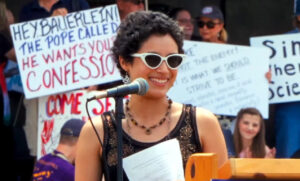
Editor in chief of The Catalyst during the making of the film: Gaby Batista. | Photos: Courtesy newcollegefilm.com
Brice Claypoole: It started in January 2023 when Governor Ron DeSantis appointed six conservative activists to New College’s board of trustees. The college, a small liberal arts school, was founded in 1960. It operates without traditional grades, with independent study projects and student-designed tutorials, allowing students to follow their academic passions. Over the years, it developed a strong LGBTQ community. DeSantis and his allies claimed that the school had begun to “indoctrinate” students with left-wing values.
Ron DeSantis: So New College, when I got elected governor, I didn’t know anything about it. ‘I’m like, what is New College?’ And it really became captive to Left ideology, gender ideology, CRT, all this stuff.
BC: This was at the height of DeSantis’s “war on woke,” as he geared up for his unsuccessful presidential run.
RDS: Florida is where woke goes to die!
BC: The new board of trustees launched a chaotic transformation of the college. They ousted President Patricia Okker, replacing her with Richard Corcoran, former speaker of the Florida House of Representatives and state education commissioner.
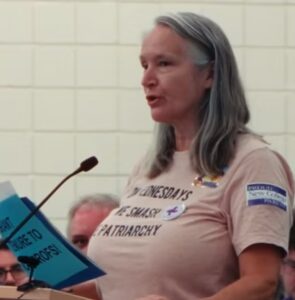
Amy Reid, former professor of French, now working for PEN America.
Amy Reid was the director of the now-shuttered Gender Studies program and the faculty representative on the Board of Trustees. In an interview with WSLR, she said the overhaul felt like an attack on academic freedom.
Amy Reid: It seemed for a while, like every Friday we were faced with someone else who had been fired from the college president to the provost, to the Dean of Diversity, to the senior research librarian, and a lot of other people in between. They chased out a number of students and they chased out a number of faculty. When the new board came on, they said that they wanted, that they were engaged in, a ‘hostile takeover’ of the college, and you actually have that quote.
BC: I believe that was Christopher Rufo?
AR: Yeah, I try not to say his name. He’s kind of like Voldemort, and every time you say his name, his ego sort of puffs up a little bit.
BC: As the drama blew up into a national controversy, it caught the attention of filmmaker and New College alumnus Harry Hanbury.
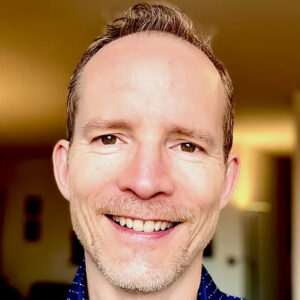
Harry Hanbury
Harry Hanbury: I’ve graduated with a degree in philosophy and sociology and went on to become a filmmaker and did a bunch of different work in film, a lot of investigative journalism work. And when the takeover happened I was very concerned. And I felt like New College had sort of saved my life as a young queer kid out of Catholic all boys military high school.
BC: To produce a film on the events at New College, Hanbury joined forces with cinematographer Patrick Bresnan, known for his work on Florida films like Pahokee and Naked Gardens. Hanbury and Bresnan travelled to Sarasota to begin filming.
HH: As we turned onto US-41 and I saw the Pei dorms. I’ve been talking nonstop with Patrick for two hours on the drive from Orlando, and when I saw them, I just started sobbing. And then when we got onto campus, I collected myself a little bit, but when we walked into Hamilton Center and I saw the Gender and Diversity Center, I’ve never had this experience: literally like my knees went out from under me and I just started sobbing because I think it represented like so much hard work and achievement by queer and trans students, female students, everyone interested in diversity, you know, students of color, to create that space. And I didn’t even know that it was gonna be… gutted.
BC: Hanbury and Bresnan decided to make the film from an unconventional perspective.
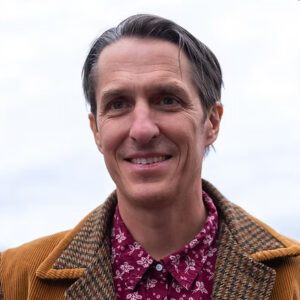
Patrick Bresnan
Patrick Bresnan: I wanted to make something that was very cinematic and very much in the voice of the students. Uh, so instead of having a big crew, you know, sound people, tons of cameras, you know, a very expensive production, we invested that money in taking the students out to eat in Sarasota. […] We got to know them. […] So that was kind of our founding principle, that we were going to invest in the students, put them first. […] We wanted the film to be in their language.
BC: The crew bought cell phones for students to record their daily lives at the college. Much of the film consists of these recordings. Slightly off-kilter and sometimes from awkward angles, they give an intimate glimpse into the lives of student-activists navigating chaotic times, juggling politics, friendship, and community. Many of these scenes depict casual conversations, students laughing and joking with each other. Others capture stark images—like piles of books thrown into dumpsters after the gender studies program was shuttered.
BC: A core thesis of the film is that the takeover of New College represents an authoritarian, even fascist assault on academia. Bresnan explained to me how he came to that view.
PB: When I first arrived at New College, it was being characterized as fascism and I definitely was very hesitant to use that term for a year and a half. But going down to New College every week, every other week, seeing what I was seeing on the campus, the books thrown away, the utter chaos, the painting over of student murals, the removing of safe places for the students, the firing of the librarian. They are using their power limiting the self-expression of the students, of the professors, creating an environment of fear. To me, that is fascism.
BC: In an email to WSLR, Jamie Miller, Vice President of Communications & Marketing at New College, disputed that portrayal.
“New College of Florida is aware of a recently released sensationalized documentary that attempts to highlight a number of inflammatory claims about the college that are void of any facts or evidence to back up the opinion of the filmmaker. Prior to the current administration, New College faced closure because of serious institutional challenges, including declining enrollment, a deteriorating and increasingly unlivable campus environment, and broader instability then [sic] ever before. In many cases, these issues stemmed from the ideological environment that had taken hold at the institution.”
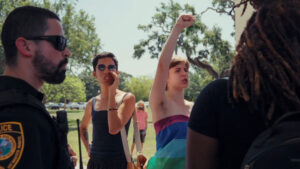
Expelled: Libby Harrity (r.)
Libby Harrity was the student senate president during the takeover of New College. She was forced out after spitting at the feet of Trustee Christopher Rufo during a heated student protest. She told WSLR that she hopes the story of New College will inspire others.
Libby Harrity: It’s important for people to remember that it starts with you and it starts with your neighborhood. It started in Sarasota. So the change starts in Sarasota. Support your community, organize, stand up, demonstrate, do it all.
BC: In that vein, First They Came for My College will soon be viewed around the country. Here’s Bresnan:
PB: We’re doing a very grassroots film festival run that will last about six months. Over that time period, we’ll be bringing the film to cities and film festivals across the country.
BC: The film will not be coming to the Sarasota Film Festival since the event is held in partnership with New College. Instead, the filmmakers say they hope to organize an independent screening in Sarasota later this year.
Details to follow.
For WSLR News, this is Brice Claypoole.
WSLR News aims to keep the local community informed with our 1/2 hour local news show, quarterly newspaper and social media feeds. The local news broadcast airs on Wednesdays and Fridays at 6pm.