With just weeks remaining on the job, the Ringling College president shares his views of the art school.
By Rhatia Murphy
Original Air Date: May 6, 2026
Host: 27 years. That’s how long Larry Thompson was at the helm of Ringling College of Art and Design. His term is coming to an end this month. On June 1, his successor will step up. WSLR News reporter Rhatia Murphy sat down with Thompson for an extended interview.
Rhatia Murphy: So I’m just finishing up my first year of studies at Ringling College of Art and Design.
Not at age 18—but at 49.
Yeah.
For me, the decision to go back to school and receive formal arts training at Ringling came down to these two things: its solid reputation and its interesting come-up among the nation’s top art schools.
And that made sitting down with the man who helped shape this place into what it is today feel a little surreal.
After 27 years, President Dr. Larry Thompson is stepping down.
And in higher education, that kind of tenure is almost unheard of.
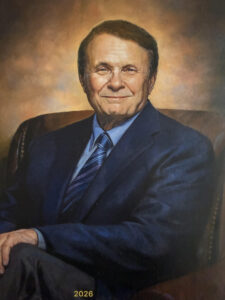
Painted portrait of Larry Thompson
Larry Thompson: The life expectancy of a college president is about five years at an institution. They move as well, but it’s very short because people they tired—or, whatever, I don’t know—they get fired. Whatever.
RM: 27 years is not short. It’s transformational.
And when Dr. Thompson first came to Sarasota, he didn’t arrive with a master plan.
He arrived with questions.
LT: I had never been to Sarasota, and I had ideas of it because I was from the north, and I thought Florida was, shall we say, the home of Mickey Mouse and Donald Duck. Sarasota is nothing like that. I was worried that would be the culture. But the reality is I spent a couple of days beforehand, and I talked to people, and they said, “Oh, no. “Sarasota is the arts and cultural capital, okay? This is really phenomenal.”
RM: But what ultimately convinced him to take the job wasn’t the city.
It was the students.
LT: Before I had my interview, I came to campus, and I saw students sitting on these concrete tables over by what used to be the library. I just came over, introduced myself and said, “How do you like this place? How do you like this Ringling College?” And they said, “Oh my God, this is the best place. I love this place.” And I’m like, “Who are these students? I’ve never heard students talk like this before,” and they just convinced me that this institution was very, very, very special.
RM: At the time, Ringling was small. Tiny, even. Six majors. A few hundred students. And a campus that, in his words, needed a little work.
But he saw potential.
And what followed was nearly three decades of expansion.
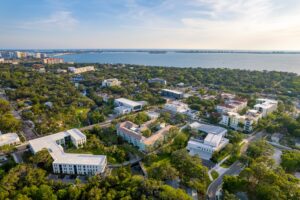
Aerial view of the campus in North Sarasota. | Photo courtesy RCAD
LT: When I came, there were six majors. Now, there are thirteen. Going through the process of adding new academic programs at a college is a laborious process. That was the big part. I thought, “Well, this has so much potential. Why don’t we look at expanding the number of majors, which then would expand enrollment?” And then after that, once we started to enroll more students, we had to find spaces for them. We had to build new residence halls, we had to build new classrooms, more laboratories—so on and so forth. I ended up now—someone counted it for me the other day—it’s, like, fourteen new buildings since I’ve been here.
RM: Very different-looking campus.
LT: Very different-looking campus.
RM: But growth wasn’t just about more buildings.
It was about embedding the school into the fabric of the city of Sarasota itself.
When he first arrived, most residents didn’t know the school or campus existed.
He knew that had to change.
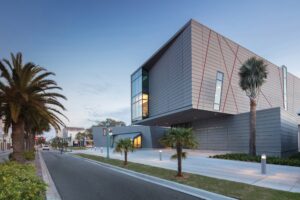
Ringling College buildings along Martin Luther King Jr. Way. | Photo courtesy RCAD
LT: I really set out to make this college really integrated with this community. Not that many people were connected at that time with the college, so I decided, “I’m going to make this college this community’s college and have the community become very engaged with it.” They responded very well. Once they got here, they fell in love with it, and they fell in love with our students. That’s the magic.
RM: That evolution didn’t happen in a vacuum.
The creative industry itself was changing—and Ringling had to change with it.
From early computer animation to motion design to virtual reality.
And now, like every creative field, it’s facing the question everyone is asking:
What happens next?
LT: People were thinking, “Well, the computer’s going to do all this, and they’re taking away jobs.” Well, that’s not the case. You still had to be an artist in order to do the stuff for computer animation. What I’ve told people is that we embraced the idea of the computer becoming the next paintbrush, and that’s what’s happened. It’s a tool. It’s a tool an artist can use. What I’m hopeful for is that AI is another big tool for artists to be able to use. Creativity is going to still be so essential to the artists because, no matter what, AI is only doing whatever has been done.
RM: Still, the future of the school isn’t without challenges.
Some of them are economic.
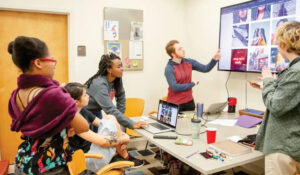 LT: The cost of higher education is is way too high because it’s very expensive to run a top-notch higher education institution. It bothers me that students have to struggle to be able to make it here. That’s why I’m a big believer in raising money for scholarships for students.
RM: Others are structural—and harder to predict.
LT: We’re seeing a decrease in number of students, especially international students who are now willing to come to the United States to get their educations because of some of the things that have happened with visas. Men are not going to college. Men are not going to college in the same way that women are. It’s a total reversal. The demographic cliff is the number of 17-18-year-olds has declined immensely, so there are fewer students to potentially go to college.
RM: And now—after 27 years of navigating growth, change, and uncertainty—Dr. Thompson is stepping away.
LT: It’s going to be tough for me. I love this place. I’ve put my entire soul into it. I do plan to travel some. I also plan to play golf. I play golf—not very well, so I’m hoping to get better. Anyway, I’m going to sleep for a while.
RM: Sleep, after 27 years.
That sounds earned.
I only got one year here under Dr. Thompson’s leadership.
He had 27.
But sitting across from him, it’s clear: This place didn’t become what it is by accident.
It became what it is because someone saw its potential early and stayed long enough to build on it.
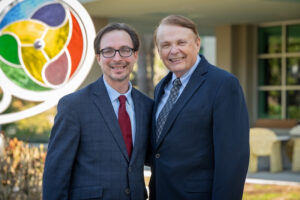
Davis Schneiderman and Larry Thompson
And now, like the students who pass through it every year, Ringling moves forward into its next chapter.
In January, the college’s board picked Davis Schneiderman as Thompson’s successor. He comes from a small private liberal arts college in suburban Chicago. During more than two decades at Lake Forest College, he has been in charge of the Krebs Center, an institution for people thinking about the arts. He was also leading research about the use of artificial intelligence in the humanities.
Schneiderman will take the helm at Ringling on June 1.
For WSLR News, I’m Rhatia Murphy.
WSLR News aims to keep the local community informed with our 1/2 hour local news show, quarterly newspaper and social media feeds. The local news broadcast airs on Wednesdays and Fridays at 6pm.
 It's drive week!
Your gift keeps 96.5 on the air. Be one of the people who make it happen.
Donate Now
It's drive week!
Your gift keeps 96.5 on the air. Be one of the people who make it happen.
Donate Now