Florida has ‘the worst conditions for cycling,’ says the state’s first bicycle lobbyist.
By Noah Bookstein
Original Air Date: June 3, 2026
Host: Two recent high-profile road deaths of bicyclists in the region have stirred up biking activists. WSLR News reporter Noah Bookstein talked to some of them.
Noah Bookstein: Florida has more bicycle fatalities than any other state in the nation. Last year alone, almost 200 cyclists were killed on Florida’s roads. In a 2024 statistic, Sarasota and Manatee ranked as the second- and third-deadliest Florida counties, respectively. Last year, in both counties combined, at least five cyclists lost their lives. Among the latest victims is Patrick Franklin, a 67-year-old Bradenton man and beloved member of the Village Idiots Cycling Club. He died in January after a truck struck him on the El Conquistador Parkway. This past weekend, on Saturday, May 30, a 35-year-old woman was killed on her bike after being struck by motorists on the Ringling Causeway.
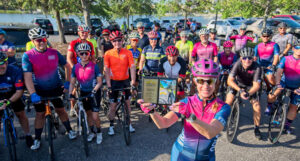
Village Idiots Cycling Club | Courtesy VICC
To understand what’s behind this disturbing trend and what we can do about it, WSLR News spoke with Mike Lasche of Florida Walks and Bikes, who is one of the state’s longest-serving bicycle advocates. He has been fighting for cyclist safety since the 1980s when he became Florida’s first bicycle lobbyist. He says the danger is baked into how Florida was built.
Mike Lasche: Unlike a lot of the U.S—say, Boston or New York City or much of the north—Florida waited to be developed until the age of the automobile. Florida had to wait for air conditioning, and Florida is kind-of post-World War II. If you look around Sarasota, you see all these old motels along Highway 41. Florida was a tourist destination spot, and it was kind-of a retirement spot, and it all boomed after World War II, but it was developed in the age of the automobile. What you have is the worst conditions for cycling. You have these trailer parks, gated communities separated by miles from the shopping center, separated by miles from the school, separated by miles from the workplaces.
NB: And the numbers reflect that history.
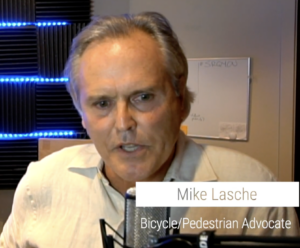
Mike Lasche
ML: One out of five bicycle fatalities in the United States occurs in Florida.
NB: Lasche says the safest path forward is supported by three pillars: education, enforcement and engineering. On education, he points to a state-approved bicycle safety curriculum he helped pass in 1987—one that was never fully implemented.
ML: But if you can inculcate these values in them as young children, then not only did they grow up to become safe pedestrians and safe cyclists but they grew up to become safe motorists as well. So that program was approved. The funding never got in, so you’ve seen limited acceptance in the school system of this program. That would be one thing I’m banging the gong for. Those bills passed in ‘87 and ‘88. They’re still current. Unfortunately, FDOT is weak on the concept.
NB: Lasche says cycling safety advocates don’t face outright opposition but often run into apathy.
ML: We don’t really face hostility so much. There’s occasional glimpses of hostility from the power brokers, but mainly, it’s more about indifference. According to the census—this is interesting—cyclists in Sarasota County comprise 0.8% of the commuters, pedestrians 0.7% of the commuters and mass transit 0.5% of the commuters. So there are more people who walk and bike to work than take mass transit. Yet who gets millions and millions of funding every year from the feds in Sarasota County? The feds give millions of dollars of funding towards mass transit.
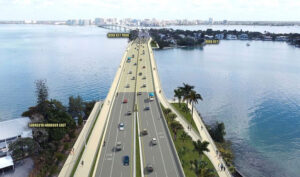
Rendering of the planned Coon Key Bridge, with bus lanes and a “multi-use path” for both cyclists and pedestrians. A bicyclist was hit by a car and killed on the bridge last weekend.
NB: He has a message for both sides of the road. For cyclists:
ML: The bicycle is a vehicle—and when I say it’s a vehicle, it’s legally recognized as a vehicle in all 50 states of the United States and its territories—so if you’re going to ride a bicycle, act responsibly. Act like a vehicle. Turn signals, stop at stop signs, stop at stoplights, use lights at night.
NB: And for drivers:
ML: Motorists, obey the laws. If you see a cyclist, recognize him as another vehicle. Occasionally, cyclists will slow you down. In bicycling, we talk about something called the tyranny of speed, where some people think, “If anybody slows me down, they’re wrong.” That’s not necessarily the case. The real rule of transportation is the person in front can determine the pace. In most situations in American traffic, a bicyclist will only slow a motorist down temporarily. The motorist has to slow down if there’s a bicycle in front, but it’s only a temporary slowdown.
NB: On infrastructure, Lasche celebrates the growing number of bike lanes in Sarasota and Manatee counties, but he is skeptical of some recent changes, including the redesigned bike lane on Ringling Boulevard. He warns that plans to move cyclists from road lanes onto multi-use sidewalk paths such as on Fruitville are a step in the wrong direction.
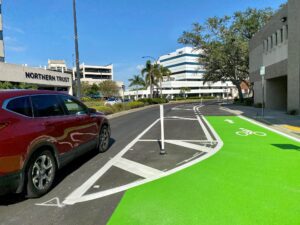
Controversial: The new Ringling Boulevard bike trail arrangement. | Photo: City of Sarasota
ML: When you’re on a sidewalk, you have limited visibility. Every driveway is an intersection. When you come to an intersection, you’re a surprise to crossing motorists. Every credible study that’s ever been done has shown that cyclists do not belong on sidewalks. Unfortunately, you have these planners moving in, and their plans for Fruitville Road are to get rid of the bike lane and put everybody on the sidewalk—what they call the “multi-use path.” So that’s a step backwards.
NB: Lasche’s bottom line is that well-designed bike lanes and safer streets for cyclists are good for everyone. Dawn Zielinski, president of the Village Idiots Cycling Club, wants everyone to remember to share the road so we can all get home safely.
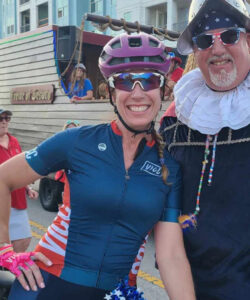
Dawn Zielinski
Dawn Zielinski: To every driver, when you see a cyclist, remember you’re seeing a human being. Slow down, stay alert, and give them space. We all share these roads. Let’s make sure everyone makes it home.
For WSLR News, Noah Bookstein.
WSLR News aims to keep the local community informed with our 1/2 hour local news show, quarterly newspaper and social media feeds. The local news broadcast airs on Wednesdays and Fridays at 6pm.
 It's drive week!
Your gift keeps 96.5 on the air. Be one of the people who make it happen.
Donate Now
It's drive week!
Your gift keeps 96.5 on the air. Be one of the people who make it happen.
Donate Now