We explain the ‘administrative review’ process.
By Noah Bookstein
Original Air Date: June 24, 2026
Host: The 1899 Fruitville project is not exactly popular. But it is advancing thanks to a process called “administrative review.” WSLR News reporter Noah Bookstein explains.
Noah Bookstein: Tennessee-based Bristol Development Group cleared another hurdle on June 17 with further approval from the city for their massive five-story apartment complex of over 300 units.
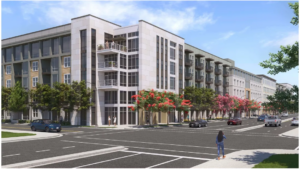
1899 Fruitville is advancing fast through the approval process. Rendering of the proposed project.
Left in the dark by their landlords, The Breakfast House, Artful Giraffe, Siegfried’s and other businesses are hoping to find out when they will need to relocate, potentially to a new location up the road.
Residents are concerned about the displacement of the local businesses and the way a massive rental complex might affect the character and traffic of the surrounding area, but they may never get to weigh in on it directly.
That’s because 1899 Fruitville is zoned as part of downtown, where site plans are processed “administratively” rather than through a public hearing—meaning city staff check the application against the code instead of a board voting on it.
Downtown site plans are considered without regard to typical thresholds, such as unit count or building size, that would normally trigger a public hearing for projects outside downtown. Projects using the city’s attainable housing density bonus follow the same path.
Staff cannot approve something the code prohibits; they’re working from defined criteria, not personal preference. A public hearing for downtown projects would happen, however, if a developer needs a rezone, requests an adjustment too large for staff to approve on their own or if someone files a successful appeal.
While staff are largely just checking an application against the code, it is not merely a box-checking exercise. Within the framework staff have to evaluate intent, compatibility and feasibility. They are also able to change some numeric standards by up to 25%.
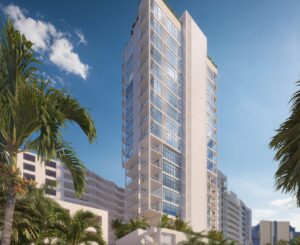
Rendering of the Obsidian
Take Obsidian, an 18-story condo tower proposed for North Palm Avenue that has become one of downtown’s most fought-over projects. The city’s Development Services Director, Lucia Panica, denied the developer’s request to shrink ground-floor habitable space, citing the code’s goal of providing a “high level of positive stimulus and interaction for the pedestrian.” A related request to shrink retail frontage by 30.5% was too large for her to decide herself. By code, any adjustment that reduces a requirement by more than 25% must go to the Planning Board, which ultimately denied the request four to one.
Why take default public hearings out of the equation for these larger projects downtown?
Back in 2000, the city hired Andres Duany, an urban planner behind a movement called New Urbanism, which pushes back against suburban sprawl by favoring density, walkability and well-proportioned architecture over car-dependent design. In 2001, the city adopted his plan for downtown.
Part of Duany’s idea is that, in order to encourage the development of downtown, politics should be stripped from the process for code-compliant projects.
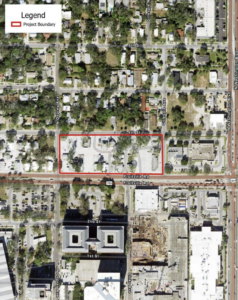
Location of the project: On the north side of Fruitville Road, near US 301. The land is zoned “Downtown Edge”.
By using what planners call form-based codes and having staff check against them, developers could expect a predictable, efficient process.
Traditional zoning regulates use, including what kind of businesses can go where, how many units a building can have and whether or not it is compatible with the neighborhood. Those are calls that can be debated in public hearings.
Form-based code flips that. It regulates the shape of a building instead, emphasizing criteria such as height and setback.
The logic behind administrative review downtown is that, if the measurements check out and the street is good, then in theory there is no need for a public vote; they just need someone with a tape measure.
While this might make sense for smaller projects such as single-family homes, whether or not to keep this process in place for downtown has been a recurring fight ever since it was adopted.
In 2016, a resident group called STOP began pushing the city to require public hearings for major downtown projects, a fight that resurfaced in 2019 when the Commission voted not to make that change.
Now, candidates for city commission have been pushing for the city to take another look at this process.
Jen Ahearn-Koch, a current commissioner running for reelection, told WSLR News that citizens’ voices need to be reintroduced to the process.
Jen Ahearn-Koch: The city needs to reintroduce the public’s voice into the approval process. Our very qualified staff must do their job, and they do their job, and they do it well. That part needs to stay. What needs to be introduced is the community’s voice in that process so that citizens are able to participate in the government and in the city where they live and how their community grows.
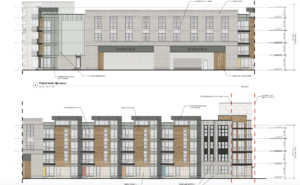
Rendering of 1899 Fruitville
NB: According to Flo Entler, another candidate for city commission:
Flo Entler: Administrative approval only works if our zone encodes are perfect, and they’re not because developers find loopholes all the time. I would like to work with staff to tighten up any loopholes, and I’d like to put the resident’s voice back in the process. We could also put the planning board back in and the commission back in and make it well rounded, have everyone’s voice in it and have a good conversation. When we’re all working together, we always end up with a much better project.
NB: And John Harshman, who is also running for city commission, says:

The owner of The Breakfast House would like to relocate some of the cottages and businesses from the Historic Downtown Village to a new location on Fruitville Road. | Photo: Werner
John Harshman: Even if you are processing through the administrative approval and you do dot the I’s and cross the T’s with your code and you’re not trying to ask for any hardships or exemptions, you still should have to have obligatory neighborhood meetings so that you are showing the neighborhood what you’re planning. In addition to having the neighborhood meeting, at that meeting, you need to have the city staff person as well as a decision maker from the developer so that they can go there and they can commit to the neighborhood.
NB: Policy on downtown administrative review could change through a zoning text amendment, which only requires a majority vote at the City Commission.
1899 Fruitville is moving through the pipeline, and whether the public gets to weigh in or not may rest with who is on the dais after this fall’s election.
Reporting for WSLR News, Noah Bookstein.
WSLR News aims to keep the local community informed with our 1/2 hour local news show, quarterly newspaper and social media feeds. The local news broadcast airs on Wednesdays and Fridays at 6pm.
 It's drive week!
Your gift keeps 96.5 on the air. Be one of the people who make it happen.
Donate Now
It's drive week!
Your gift keeps 96.5 on the air. Be one of the people who make it happen.
Donate Now