And it is seeking jail for anyone talking about it.
By Michael Barfield/Florida Trident
October 18, 2026
The Republican Party of Florida is threatening criminal prosecution of television stations, the Democratic Party and, by the terms of its own legal theory, anyone who repeats a Leon County grand jury’s finding that high-ranking state officials diverted $10 million in the Hope Florida scandal.
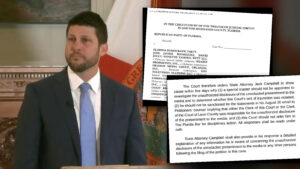
Graphic: Florida Trident
In a lawsuit filed late Friday night and a letter sent the same day to station managers across Central Florida, the party argues that the grand jury’s report and its findings became contraband on Oct. 7, when a state appeals court ordered the report erased. Under the party’s theory, broadcasting the report’s “content, gist, or import” is now a first-degree misdemeanor and criminal contempt of court.
It also requested that the Florida Department of Law Enforcement and prosecutors investigate the media stations.
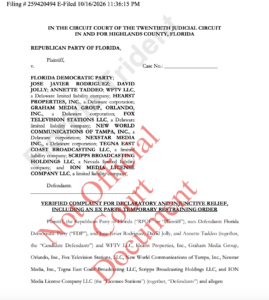
The verified complaint, filed in Highlands County circuit court, asks a judge to issue a temporary restraining order without notice to the other side. It names the Florida Democratic Party, three of four statewide Democratic candidates, and the owners of 11 television stations in the Orlando and Tampa Bay markets, including WFTV, WESH, WKMG, WOFL, WTVT, WFLA, WTSP and WFTS.
 The target is a 30-second spot paid for by the Democratic Party and approved by David Jolly for governor, Jose Javier Rodriguez for attorney general, and Annette Taddeo for chief financial officer. The ad says: “A leaked grand jury report found taxpayer money was quietly moved into a dark money political committee that James Uthmeier controlled, not to Florida families. They found $10 million was misappropriated.” It closes with the words “conspiracy, concealment, corruption.”
Uthmeier, the sitting attorney general, is on the Nov. 3 ballot. The Republican Party’s complaint describes him as “the candidate the advertisement targets.”
The case has been assigned to Circuit Judge Heather Beato of the Tenth Judicial Circuit, which includes Highlands County. Gov. Ron DeSantis appointed Beato to the bench in June 2020. Before that she spent 18 years as an assistant state attorney in the Tenth Circuit, prosecuting cases in Polk, Highlands and Hardee counties. She lives in Sebring, where the court sits, and holds degrees from the College of William and Mary and the Florida State University College of Law. No ruling has been entered on the Republican Party’s request for an emergency order.
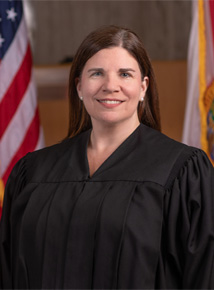
Judge Heather Beato
The governor’s lawyer who screened judicial candidates for DeSantis at the time was Joe Jacquot, his general counsel from January 2019 to October 2020. Jacquot oversaw the selection process for five Florida Supreme Court justices and more than 100 lower-court judges, including Beato, as Politico reported in June. Beato is handling the case Uthmeier’s office filed against OpenAI. Jacquot represents OpenAI and its CEO, Sam Altman, in that case. Jacquot is now a shareholder at Gunster, where he represented Andrew Sheeran, one of the officials who won expungement of the Hope Florida grand jury report from the First District Court of Appeal. Sheeran drafted the provision that sent $10 million of the Centene settlement to the Hope Florida Foundation.
A criminal statute as the hook
The suit rests on the First District Court of Appeal’s Oct. 7 opinion, written by Judge Lance Neff, ordering the 116-page presentment expunged “in its entirety.” That ruling, as the Trident has reported, was issued after the only party fighting to make the report public was kept from learning the appeal existed.
Under the Court’s own rules, the ruling is not final until 15 days after it was entered, or until disposition of any motion for rehearing. At the earliest, the ruling would not go into effect until this Friday. When asked whether the lawsuit filed was premature since the ruling is not yet final, Republican Party of Florida chair Evan Power told the Trident “they’re not going to change their minds.”
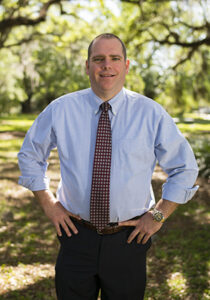
Jack Campbell
Meanwhile, the appellate court has ordered State Attorney Jack Campbell to explain why the court should not appoint a special master to investigate how the unredacted grand jury report reached the media and whether the court’s injunction was violated. The court order also instructed Campbell to demonstrate why he should not be sanctioned for an Aug. 26 email to lawyers for Uthmeier and others suggesting that a clerk of the appeals court or the Leon County Clerk was responsible for the leak, and why he should not be referred to the Florida Bar for discipline. Campbell is required to provide answers under oath within five days.
The Republican Party argues the ruling changed the legal status of the report’s contents. Because the grand jury summarized witness testimony, the party says, anyone who knowingly broadcasts the “content, gist, or import” of that testimony violates section 905.27 of the Florida Statutes. A violation is a first-degree misdemeanor and criminal contempt of court.
“The law then is straightforward,” party lawyer Benjamin Gibson of Shutts & Bowen wrote to station managers on Friday. “Knowingly broadcasting advertisements built on the contents of the confidential Presentment is criminal conduct in Florida.”
Gibson’s letter went further than the lawsuit. It told the stations the party was “referring this matter to the Florida Department of Law Enforcement and relevant prosecutorial authorities.” Copies went to FDLE Commissioner Larry Keefe, Statewide Prosecutor Brad McVay, and the state attorneys in 11 of Florida’s 20 judicial circuits. McVay works in Uthmeier’s office.
The lawsuit was filed by a different firm, Sasso & Sasso of Maitland.
What the party wants
The complaint asks for three things. First, an immediate order, entered before the defendants can respond, barring the ad from airing. Second, after a hearing, a temporary and then permanent injunction. Third, a declaration that the stations may not lawfully run the ad and that the Democratic Party and its candidates may not lawfully place it.
The injunction the party seeks is not limited to this ad. It would bar the defendants from broadcasting “any other advertisement or material that relays the content, gist, or import of the testimony and evidence summarized in the expunged Presentment.”
The timing, the complaint says, is the reason for urgency. Mail ballots are already out, and early voting begins Monday in many counties. “Voters who cast ballots on the strength of the Advertisement can’t recast them,” the party wrote.
Why Highlands County
None of the defendants is based in Highlands County. The Democratic Party is in Tallahassee. The stations are in Orlando, Winter Park, Lake Mary, Tampa and St. Petersburg. The Republican party’s headquarters are in Tallahassee.
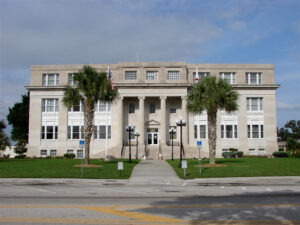
Highlands County courthouse. | Photo: Wikipedia
Power said he didn’t know why the complaint was filed in Highlands County. The complaint says venue is proper in Sebring because the stations’ signals reach the county and “the cause of action accrues here, where the Advertisement is scheduled to air.” Under that theory, the suit could have been filed in any county within reach of a Tampa or Orlando broadcast tower. The party chose a rural county of about 100,000 people. The complaint’s caption places the case in the Twentieth Judicial Circuit but Highlands County is located in the Tenth Judicial Circuit.
The complaint states that a certification by counsel explaining why notice should not be required “follows the signature block.” No such certification appears in the copy filed with the clerk.
The First Amendment problem
The party anticipates one defense and tries to head it off. Federal law bars broadcasters from censoring ads by candidates for office, and the U.S. Supreme Court held in 1959 that stations cannot be sued for libel over ads they are forbidden to edit. The complaint concedes that this immunity “may be invoked to bar after-the-fact libel remedies against the Licensee Stations.” That, the party says, is why it needs an injunction instead.
The party’s answer is that the federal shield covers defamation, not a state criminal statute on grand jury secrecy.
The suit does not mention that the U.S. Supreme Court has already struck down part of the same Florida statute. In Butterworth v. Smith, decided in 1990, the court held that section 905.27 could not be used to stop a grand jury witness from describing his own testimony once the grand jury’s term ended.
Nor does the suit address a more basic fact. The presentment has been public since Aug. 26, when a Miami news organization published it in full. The First District’s opinion, which the party attached to its complaint, describes the report’s contents at length, including the $10 million figure and the “sophisticated scheme” finding. The opinion is a public record published on the court’s website. The Trident’s reporting is also based on publicly available information.
Attorney Andrea Flynn Mogensen said the relief sought by the Republican party would violate the legal principle of prior restraint. An order forbidding speech before it occurs is a prior restraint, a form of censorship courts have treated as the most serious. That legal principle is a cornerstone of democracy, she said.
“If you look back at the purpose of the First Amendment it is to prevent the government from silencing the press. We consent to be governed in this country. If informing voters about what their government has been doing is made unlawful or prohibited, democracy will inevitably collapse.”
The party’s complaint calls its request “narrowly tailored” and says it “does not ask the Court to restrain commentary on the candidates, the settlement, or the First District’s opinion.”
The opinion as evidence
The complaint relies on the statement by the First District Court of Appeal that the $10 million “was never public money,” a description of the grand jury report as “careless in its grammar, mistaken in its law, and unfaithful to its own record,” and a footnote suggesting the media’s publication of the report “may itself have violated section 905.27.”
That footnote is the closest the opinion comes to supporting the party’s theory. Neff, appointed by DeSantis in March, wrote that the court “express[ed] no view on the lawfulness of its publication by the press.”
The Democratic Party, the three candidates and the station owners had not responded to the complaint as of the time of publication.
The case is Republican Party of Florida v. Florida Democratic Party et al., filed in the Circuit Court for Highlands County.
Michael Barfield is an award-winning investigative reporter who helps strengthen transparency and accountability across Florida. He assists reporters and the public with public records questions and requests, and he oversees and supports the organization’s litigation to enforce open government. He’s a frequent lecturer on Florida’s Public Records Act and Sunshine Law, serves on the governance committee of Investigative Reporters & Editors, and is a member of the Society of Professional Journalists. Barfield is a former President of the ACLU of Florida, a life member of the Florida Association of Criminal Defense Lawyers, and has twice been named by Sarasota Magazine as one of the most influential people in Sarasota. He lives in Sarasota with his wife, Iru.
This article first appeared on https://floridatrident.org/florida-gop-lawsuit-hope-florida-ad/ and is republished here under a Creative Commons Attribution-NoDerivatives 4.0 International License.
WSLR News aims to keep the local community informed with our 1/2 hour local news show, quarterly newspaper and social media feeds. The local news broadcast airs on Tuesdays and Thursdays at 6pm.
 It's drive week!
Your gift keeps 96.5 on the air. Be one of the people who make it happen.
Donate Now