Sarasota’s Avenue of Art was erased in preemptive compliance with an FDOT directive.
From the January-March 2026 issue of Critical Times. Print versions are available for free at WSLR+Fogartyville and other community gathering spaces in Sarasota and Manatee counties.
By Dania Hefley
The grey paintover of vibrant Burns Court sidewalk artworks in late summer has escalated from a Sarasota controversy into a potential federal lawsuit, intensifying the debate over local control and creative expression in Florida. Some of the impacted artists are actively pursuing a case under the federal Visual Artists Rights Act (VARA) against the City of Sarasota and potentially the Florida Department of Transportation (FDOT).
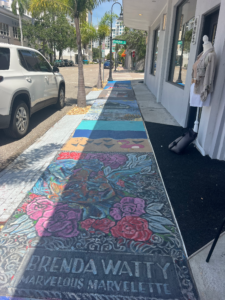
Sidewalk murals in Burns Court hours before they were removed in August 2025
The collection of sidewalk artworks, known as Avenue of Art (Avenida de Colores), was made over 4 years and included nearly 300 paintings depicting the city’s history, culture and people. It was “the largest community public art installation ever created in Sarasota County,” said Denise Kowal, Avenue of Art organizer, neighborhood property owner and founder of the Sarasota Chalk Festival. But it was not part of the City of Sarasota Public Art program.
Its swift removal, carried out with grinders and grey paint over a holiday weekend, followed an FDOT directive that forced the City’s hand, threatening a loss of critical state funding.
The controversy stems from a state legislative push for uniformity on roadways. Senate Bill 1662, signed into law last June, requires all public roads in Florida to comply with the state’s updated traffic control device standards, which are stricter than national guidelines.
FDOT followed up with a directive citing the new law and prohibiting “pavement or surface art on travel lanes, paved shoulders, intersections, crosswalks, and sidewalks.”
The state agency argues the art poses a safety risk, distracting motorists and confusing autonomous vehicles. But critics of the measure say it’s a politically motivated attack on artistic expression and LGBTQ+ symbols and colors.
Sarasota, like other Florida cities including Orlando—which had a rainbow crosswalk that honored the victims of the Pulse nightclub mass shooting—was given until September 4, 2025 to remove all noncompliant art or face having state funds withheld. That included the Pride rainbow crosswalk at the intersection of 2nd Street, Cocoanut Avenue and Pineapple Avenue, and the sidewalk murals at Burns Court.
The City ultimately complied despite protests from artists, activists and community members. Kowal stated the work was removed without communication or discussion from the City after the directive was made.
Kowal said she is not a plaintiff in the potential lawsuit. Her role has been to support artists as they explore legal options, including helping connect them with attorneys and understand the process, rather than pursuing legal action herself, she said.
For the creators behind the murals, the removal was not just a bureaucratic shift but a personal and professional blow. Luther Rosebaro, a veteran of the Sarasota artscape with 17 murals on the Avenue of Art, wrote in an email that he initially feared the move was a targeted attempt to “erase Black history.” Upon seeing the entire installation being ground away, he described a profound sadness for the “love and hard work” lost.
Although the City’s 2021 permit designation referred to the art as “impermanent,” the artists’ understanding of the project was quite different. Both Rosebaro and Jessica Dirkes, an artist with deep local ties to Ringling College of Art and Design and the Sarasota circus community, stated they believed the sidewalk murals were meant to be long-term public artworks. Rosebaro noted that paint was specifically “sealed with poly to enable it to last a long time.” Dirkes corroborated this, stating it was explained to her that the art would be “preserved with several coats of clear, so that they would last for many years of local enjoyment.”
Both artists expressed skepticism regarding the state’s safety justifications. Rosebaro argued that the art was on the sidewalks, not the travel lanes, and that the only way to truly view it was to “park your vehicle and walk,” rendering the “motorist distraction” argument moot. Dirkes was more pointed, labeling the state’s directives as “groundless” and “ill-informed.”
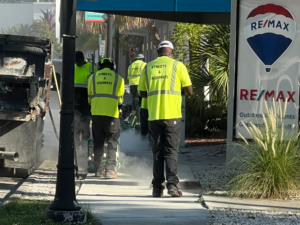
Crews grind out sidewalk murals in Burns Court
Kowal questions why City officials did not challenge the state enforcement of the new law or formally request exemptions for the Avenue of the Art. “We have examples like Fort Lauderdale that fought against the memorandum to remove the artwork,” she said.
The potential legal challenge hinges on VARA, which protects works of “recognized stature” from destruction.
Rosebaro stated that a “lawsuit should be filed,” acknowledging that it may jeopardize his chances of participating in Sarasota’s official Public Art Program. Dirkes echoed this sentiment of defiance, urging the community to be “bold, innovative, and independent of dictators” who seek to turn the “Land of Sunshine and Color” into “another shade of grey.”
While the ACLU of Florida is monitoring the situation and attorney Vivek Jayaram, who advises creatives, is consulting with some of the artists, the potential case faces a significant hurdle: the installation’s original permit.
The 2021 temporary events permit for Avenida de Colores, approved by then City Manager Marlon Brown described the paintings as “impermanent” and set an initial removal date of September 30, 2021. It was then extended to January 1, 2022. After that, another permit addendum included April 4-15, 2022 as active painting dates but did not include an end date to the exhibition. Avenida de Colores via Kowal agreed to retain a removal service as part of the permit agreement, and the extension wording states, “The condition and removal will be at the discretion of the City Manager and The Office of Public Art.” Despite the indefinite end date, the original “impermanent” designation and the “discretion” wording may complicate the argument that the works were protected as permanent art.
The City of Sarasota, meanwhile, is focusing on its expanded Public Art Program as its path forward.
Public Art Administrator Ciera Coleman said new initiatives, including competitive mural commissions and digital art projects, are part of a long-term Public Art Plan approved in 2023. She also clarified that these opportunities are not a specific response to the Avenue of Art controversy.
A key question now facing the local arts community is whether an artist’s participation in the potential VARA lawsuit would disqualify them for government-facilitated public art commissions.
“I think in general, it requires a partnership and a collaboration with artists,” Coleman said. “And so we have to work hand in hand very productively and very thoughtfully to move these projects forward and to have them be successful.”
Despite the disappointment, Kowal holds a defiant view of the future. “Art is ever changing, and this will not break us; it will make us stronger, and you have to fight for what’s important to you.”
Dania Hefley, a senior at New College of Florida, was a WSLR News intern for the Fall 2025 semester.