The notorious immigration center is history. One former detainee tells WSLR what he faced.
By Ramon Lopez
Original Air Date: June 26, 2026
Host: The immigrant detention center in the Everglades is shutting down for good. In a WSLR exclusive, our reporter Ramon Lopez interviewed a Canadian businessman who spent time at Alligator Alcatraz before he was deported.
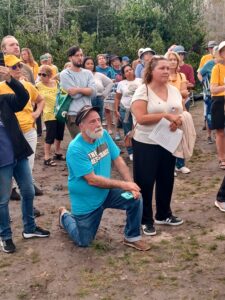
Protest outside the detention center | Photo: Lopez
Ramon Lopez: Florida Governor Ron DeSantis held a news conference Thursday at Alligator Alcatraz. DeSantis went to the remote site in the Florida Everglades to formally announce that the notorious immigration detention center was no longer open for business.
Flanked by White House Border Czar Tom Homan, DeSantis said the facility opened in July 2025 had served its purpose, was now officially closed and would not be re-opening. All the undocumented immigrant detainees held there until late last week were transferred to other federal detention centers or deported.
On June 21, word of Alligator Alcatraz’s demise drew a mere 75 protestors there for the last time. But for the past 47 Sundays, as many as 300 people would gather outside the isolated detention center for Freedom Vigils.
Last Sunday’s small final demonstration was once again conducted by Noelle Damico, Director of Social Justice at the Workers Circle. She labeled Alligator Alcatraz a “failed experiment in cruelty by the Trump and DeSantis administrations.”
She said the protests supported by faith, community and immigrant groups exposed “brutal abuse, including torture, and ongoing violations of due process,” charges denied by DeSantis and senior Trump administration officials. Damico exclaimed: “This fight for our constitution, human dignity and freedom continues, supported by this decisive victory.”
Amnesty International and a handful of U.S. lawmakers said conditions at Alligator Alcatraz were cruel, degrading, inhuman and unsanitary. Lights were on 24 hours a day and the quality of food and water was poor. There was limited access to showers. Investigators found overflowing toilets with fecal matter seeping into where people are sleeping. Immigrants and environmental groups sued to shut down the facility.
Douglas Dixon is a Canadian who got his green card in 2019. In an exclusive interview with WSLR news, the 61-year old said he had moved from Montreal in 2005 to raise his family on Florida’s Gulf Coast. He was asked: Why Florida?
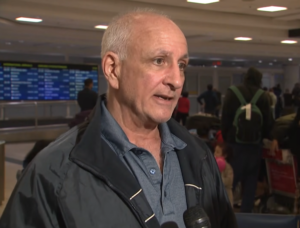
Douglas Dixon | Screenshot via CTV
Douglas Dixon: For the weather. There’s no more complicated answer than that.
RL: Dixon lived in Naples and worked in Port Charlotte for more than two decades. That is until February 10 when he was taken into custody by ICE agents after arriving for an off-schedule meeting with his probation officer. Dixon said the appointment was a setup.
DD: I turned the corner, and there they were, all the ICE people. They grabbed me, took me up against the wall with a pat-down and all that. By then, I’m shaking like a leaf because I don’t know what the hell is even going on here. Took my phone, shut it off, and then they stuck me in handcuffs with a bunch of other detainees that they had picked up on that day. Then we sat there and waited and waited and waited until they said it was time to go.
RL: Dixon was deported back to Canada on April 15 without his wife JoAnn, grown-up son and two daughters and two grandchildren. They weren’t allowed to say goodbye at Miami International Airport, where his handcuffs were finally removed, and he boarded a commercial jetliner bound for Toronto to face the unknown.
All had gone well for Dixon until the COVID pandemic, when he was forced to shutter his smoothie shop in Port Charlotte. During that time, Dixon says he fell behind $32,000 in unpaid state sales taxes. In 2022, he pleaded “no contest” to tax evasion. He agreed to a monthly repayment plan. Over the next three years, Dixon paid back two-thirds of the amount, but still owes the state of Florida about $12,000. A warrant, which he knew nothing about, was issued for his arrest.
Dixon said if he knew then what he knows now, he would have done things differently.

Playing hockey with fellow Canadians in Florida. | Photo courtesy Dixon
DD: Until you’re placed in these kinds of situations, you’re not a professional. You don’t know what to ask and what is what. I’m running a smoothie operation. I’m not an illegal with the lawyers and police. I didn’t know what was going on. How do you know what questions to ask to inform yourself? Looking back on everything, would I have done it differently? 100%. 100%, I would have done it differently. Could I have done it differently? For sure. But at the time, you don’t think that way. That’s not how it goes down. Am I to blame? Yes, I’m to blame.
RL: Dixon spent nine miserable days at Alligator Alcatraz and 53 days at the Glades County Detention Center in Moore Haven, Florida, where conditions were not much better.
He was given one set of underwear, a pair of flip-flops and an orange jumpsuit to wear. Dixon was locked up in a communal cell behind metal fencing that housed 16 bunk beds and 32 detainees, open urinals and toilets.
Dixon described the conditions there.
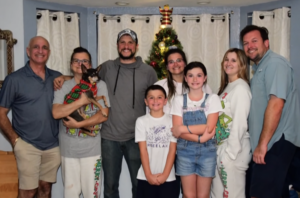
Douglas Dixon and family | Photo courtesy Dixon
DD: The lights are on all the time. There’s never a dark area. The noise was unbearable. You could hardly hear yourself think because the generators are going 24/7. Three meals a day; breakfast, lunch and supper. Food was cold. Nothing was ever warm. It was always cold because it was brought in in pre-packaged boxes. It was sufficient to keep you alive. You weren’t gaining weight with it.
RL: Dixon dropped 18 pounds.
Dixon said the majority of people inside Alligator Alcatraz were of Latin descent. Trump said his illegal immigrant dragnet aimed to round up menacing migrants and so-called “worst of the worst” criminals. But Dixon found none of them there.
Doug Dixon does not consider himself a criminal and was surprised by his arrest.
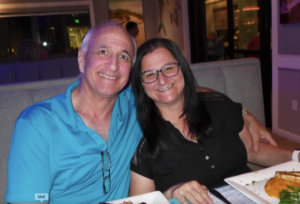
Dixon and wife Jo Ann Collison | Photo courtesy Dixon
DD: I am not a threat to society, and I am not a danger to any person on the planet. This was a monetary infraction. Not only that, I was paying my restitution, doing my probation.
RL: During his time there, Dixon said he did not see guards strike detainees or any inmate fights. He did see his cellmates cluster together to read the Bible and pray. He said everybody was supportive, just trying to help everybody get through.
No visitors were allowed at Alligator Alcatraz. By choice, Dixon also did not see any family members during his Glades stay. He explains why.

Tearful Zoom interview from Florida: Dixon’s daughter Amy Bazley (left) and wife Jo Ann Collison. | Screen shot CTV
DD: You’ve got to understand that the emotional things that are going on in a person’s mind at that point because of the way they’ve been degraded and put down—you don’t want to see a person from your family. It’s not that you couldn’t see a family member if they wanted to come visit at the Glades Detention Center, but nobody was taking advantage of that because of the worst emotional toll that it would take on that person..
RL: Dixon was elated to board his freedom flight, but he fears flying, and he teared up.
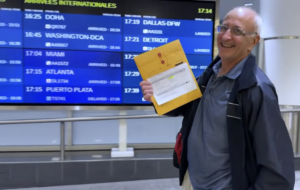
Douglas Dixon arriving safely in Toronto. Screenshot via CTV
DD: I was scared to death because that was one of my first flights, but the freedom of no longer having handcuffs and the officers being able to control me was like gaining freedom again. I had tears in my eyes all the time. Tried to hold back a few, but they get to points where you can’t, and I was crying when I was talking to the stewardess, telling her it was my first flight, and I was a little nervous and scared, and I didn’t have anybody there, so she said, “We’ll keep an eye on you. Don’t worry. We’ll take care of you.” It’s just hard when you don’t have family around in those kinds of moments in time.
RL: This has been Ramon Lopez with a WSLR News special report.
WSLR News aims to keep the local community informed with our 1/2 hour local news show, quarterly newspaper and social media feeds. The local news broadcast airs on Wednesdays and Fridays at 6pm.
 It's drive week!
Your gift keeps 96.5 on the air. Be one of the people who make it happen.
Donate Now
It's drive week!
Your gift keeps 96.5 on the air. Be one of the people who make it happen.
Donate Now