Thousands of condo, apartment and retirement home residents in Sarasota may be affected.
By Nic Steinig
Original Air Date: June 17, 2026
Host: The governor signed into law an insurance bill affecting commercial policies that will likely raise costs for condo dwellers and retirement home residents. SB 1028 is the brainchild of Joe Gruters, the outgoing state senator from Sarasota who now heads the Republican Party nationwide. Two Florida insurance industry groups and state regulators had urged DeSantis to veto it, in part because it seems to heavily favor just one particular insurance business that happens to be a big donor to Republican campaigns. Nic Steinig fills us in.
Nic Steinig: Yesterday, Governor Ron DeSantis signed into law a bill sponsored by Sarasota Senator Joe Gruters. The bill’s alleged intent is to transfer commercial insurance policies held by Florida’s publicly funded insurer of last resort, Citizens Property Insurance Company, to the private market.
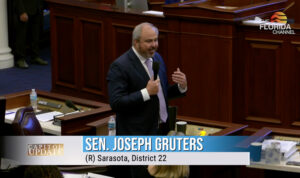
Gruters, on the Florida Senate floor earlier this year. | Still shot Capitol Update
Supporters of the bill have called it a necessary step to further reduce the odds that a major storm will cause Citizens to go belly-up from widespread damage covered by its policies. Between 2020 and 2023, the number of policies held by Citizens rose dramatically due to the private insurance crisis in Florida. Since then, a “depopulation” program enacted by lawmakers at the end of 2023 brought it back under control, causing it to fall in just three years from its slot as the number one insurer in the state, with 1.4 million policies, to holding only one fourth as many policies.
That 2023 depopulation program focused on moving personal policies to the private market. The bill proposed by Senator Gruters and now signed into law would add commercial policies—those owned by condominium associations, HOAs, apartments, group homes and more—to those transferred to the private market. A “clearinghouse” will be established to oversee the transfer of policies to the private market, and a third-party administrator will be assigned to manage it.
The catch? The bill’s language strongly favors Ryan Specialty, a Chicago-based firm whose founder, Patrick Ryan, and his wife, Shirley Ryan, have contributed over $30 million to Republican congressional committees, to be selected as the programs administrator. Ryan Specialty also has a potential conflict of interest, as it directly deals in the surplus lines insurance market.
In November, a month before the bill was officially filed, Ryan Specialty donated $750,000 to two political committees, which then distributed the funds to several other organizations, with $500,000 allocated to the Florida Republican Senatorial Campaign Committee.
According to documents obtained by investigative reporter Jason Garcia, Ryan Specialty senior executive Mark Katz even edited the bill directly.
Which begs the question: what is so favorable about being designated the depopulation clearinghouse administrator that would cause a Chicago firm to lobby Florida legislators for the role?
Florida Surplus Lines Association Chair Dave DeMott told WSLR back in March that the administrator can commoditize the risk they oversee and could potentially take generous commissions on deals they structure for private investment dollars. In other words, they can leverage the role to rake in a killing, leaving Florida-based firms far behind.

Shirley (2nd l.) and Patrick Ryan (3rd l.) celebrate Ryan Specialty’s listing on the New York Stock Exchange in July 2021. | Photo: RSG
Both the Florida Surplus Lines Association and the Florida Association of Insurance Agents publicly opposed the bill and lobbied against it.
As reported by Jason Garcia, Al Geraci, president of the Florida Surplus Lines Association, wrote this in a March 11 email to its members:
“Empowering a single entity to operate the clearinghouse would create a significant structural market advantage, raising concerns about competition, access, and balance within the marketplace.”
The bill also faced opposition from the Florida Office of Insurance Regulation, which took issue with its lack of policyholder protection and regulatory oversight.
As signed yesterday, the bill mandates that any Citizens policyholder who receives an offer from a private insurance company for coverage within 15% or less of their current Citizens policy premium will have their Citizens policy terminated. This is the mechanism used to push policies through the clearinghouse and depopulate Citizens.

Patrick Ryan
Crucially, the bill also allows surplus lines Insurers to make an eligibility-terminating offer, provided that already-admitted traditional insurers get the first pass. This was a major reason the Florida Office of Insurance Regulation took issue with the bill, as surplus lines Insurance is almost entirely unregulated by the state and is meant to provide coverage for high-risk ventures.
Here is Insurance Commissioner Michael Yaworsky, elaborating on some of the risks associated with using surplus lines insurance at a Senate committee hearing:
Michael Yaworsky: The bargain for exchange belief in the surplus lines market is that the consumer who is going to purchase that type of product is of a sophistication or wealth that they do not necessarily need those state-backed protections. Therefore, there is no form or rate review to ensure that those items comply with Florida law.
In the surplus lines market, all the insurer has to do is provide the manifestation of intent to renew to meet the deadline requirements in that space. They do not have to disclose what the new premium might be—what new terms of coverage might be—what a number of other provisions might be in this place—up until the day before the new policy is set to renew. That can be a significant challenge for a number of consumers that are in this residual marketplace right now that is Citizens.
NS: Yaworsky also called for further changes to the bill: He proposed limiting the clearinghouse administrator to be based in Florida and be free from conflicts of interest and wanted to add language to the bill that would have made any eligibility-terminating offer include any additional fees the insurer may charge to prevent bloated fines being pushed onto the policyholder without recourse.
Ultimately, neither of those changes was accepted by the legislature.
That could leave Citizens policyholders in a precarious position, possibly forced to accept a surplus lines Insurance option they can’t easily manage with little regulatory oversight. Nearly 70% of Citizens’ policies are for property built before 1984, according to Citizens Property Insurance Company.
According to Citizens, there are 150 active commercial policies in Sarasota County. If statewide trends hold in Sarasota, about half of those could be residential businesses such as local apartments, condominiums, retirement homes and other large residential properties.
WSLR reached out to the Downtown Sarasota Condominium Association last March, a group that coordinates with over 40 local condominiums. While the Association declined to take a stance, it shared concerns expressed by Sarasota condominium associations. These include fears that insurance hikes would force condos and HOAs to raise prices, unease about the risks and complexity of using surplus lines insurance and discomfort at being pushed into the private market, where insurance periods are shorter and more difficult to negotiate. 
Now, the clearinghouse program will be a reality that local commercial policyholders must contend with. The bill requires Citizens to assign a commercial clearinghouse administrator and the Office of Insurance Regulation to approve the program within three months. Citizens must also implement two clearinghouses by January, one for surplus lines and one for traditional admitted insurers.
If local commercial and residential properties face 15% insurance rate hikes and the additional costs of holding surplus line insurance, those costs would likely be passed on to everyday tenants through condo fees, HOA fees and rent.
We reached out to Joe Gruters by phone and by email but did not receive a response before the deadline.
Reporting for WSLR News, Nic Steinig.
WSLR News aims to keep the local community informed with our 1/2 hour local news show, quarterly newspaper and social media feeds. The local news broadcast airs on Wednesdays and Fridays at 6pm.
 It's drive week!
Your gift keeps 96.5 on the air. Be one of the people who make it happen.
Donate Now
It's drive week!
Your gift keeps 96.5 on the air. Be one of the people who make it happen.
Donate Now