State and local programs offer help. The Florida Farm Bureau-supported ‘Mind Your Melon’ is one of them.
By Gretchen Cochran
Original Air Date: December 17, 2025
Host: If you believe running a farm is a laid-back job, think again. Gretchen Cochran has that story.
[Rooster crows]
Gretchen Cochran: Hear that? It’s certainly not the ho, ho, ho of this holiday season. Rather, it’s a reminder that some of us are not faring so well right now, particularly those in our farming community.
Suicide rates for farmers are two to five times higher than the national average. The National Rural Health Association says there is a rising rate of depression, anxiety and suicide among them and the pressures are growing.
A first-of-its-kind Florida study released In June sounded the alarm. While 67 percent felt depressed, slightly over half had never visited a mental health professional.
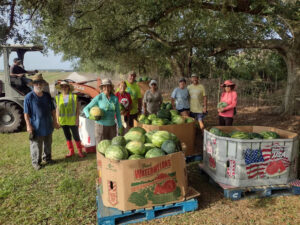
Bringing people to the farm: Community Harvest gleaners in Sarasota. Photo courtesy Community Harvest
Marshal Sewell and his wife created the “Mind Your Melon” Foundation. His story echoed those of many today. He had grown up in Plant City, Florida where his family maintained a fifth-generation large strawberry farm. The area is known for its huge Strawberry Festival, next upcoming in February. But Sewell’s family won’t be there. A crop failure’s stress in 2007 pushed his father to end his life. Sewell decided then he would work to aid farmers in some way. Now, 18 years later, with the help of the Florida Farm Bureau, he and his wife spearheaded a study focusing on the mental health of farmers and ranchers.
Note the sale of the 340-acre Albritton blueberry farm on Clark Road on the south side of Sarasota a few years ago. It had been the longest-running family-owned farm in Sarasota County.
According to a “Sarasota Magazine” interview, an Albritton relative summarized: “It’s a difficult livelihood,” she said, citing the year-round international availability of fruit, including blueberries, as a particular challenge. The Mexican berry market has made timing critical for a commercial harvest; if you’re just a week or two late with your harvest, it’s the difference between a profit or complete loss.
In another case more recently, the 84-year-old Mixon Farms in Bradenton was sold to Manatee County. The sale was marked by a celebration just last month. The farm was known especially for its oranges. But a Mixon relative noted the decline of the citrus industry in an interview on ABC News.
She cited the pressures of free trade agreements, government regulations and reduced farm subsidies and the damage of Hurricane Ian.
Then she added the citrus greening disease that reduced Florida orange production by 92 percent over the last 20 years.
Is it any wonder the “Minding Your Melon” study this year found that 67 percent of Florida farmers queried had felt sad or depressed?
Annie Miller has a five-acre farm near Arcadia. She raises animals for purchase, primarily pigs, rabbits and chickens. Because she raises animals and garden vegetables, she figures she’s somewhat protected from the financial stressors of the large farms.
She calls what she does “regenerative farming” using practices to nurture the soil rather than deplete it. We talked to her on her cell phone as she was driving down the road, en route to a class she was teaching at Myakka State Park.
She had great sympathy for what she called “commodity farmers” who work the larger acreages.

Annie Miller
Annie Miller: We’re regenerative farmers because we’re biodiverse. We have multiple income streams, so we don’t have those same financial pressures. If prices go down on one item, I’m selling a different item. That takes a lot of financial strain off. We’re also direct-to-consumer, so we get to set our prices. On the other side, it can be stressful for a lot of farmers because you actually have to go out and sell. You have to market. You have to talk to people. You have to be [???].
GC: One of the major findings in the “Mind Your Melon” study is the isolation borne by farmers and ranchers, particularly those on the large acreages. Miller works with a network of farm people to solve problems, sometimes on social media. She has formed a collective to buy animal feed and another to buy seeds.
AM: It’s the small farmers that are making it happen and feeding the community. I think that that [???] also takes a lot of the stress off small farmers because we get to see the smiles on the faces of the people we serve.
GC: Miller works with Andrew Hudson at Community Harvest which is coming at the farmer isolation issue from a different angle.
Community Harvest has a gleaning program in which clusters of volunteers go to farms after the harvest and gather the odd pieces of fruits or vegetables remaining.
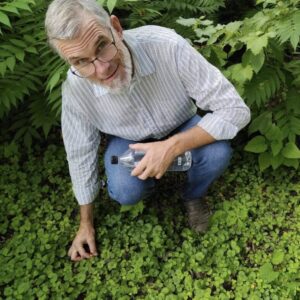
Andrew Hudson. Photo courtesy of Community Harvest
Andrew Hudson: I was a farmer for 15 years. I’m also a Mennonite pastor. Part of what we’re offering is just a listening ear and encouragement. We’re developing relationships that are supportive, and we’re hoping that they’ll be less isolated by their contact with me but also by the gleaners coming out and us getting more people to visit their farms.
GC: The financial stresses are great, but an even greater stressor is climate change.
AH: We all know pretty much every season going forward is going to be above average. The farm I was at—and I know several other farms—because getting hit by hurricanes is becoming normal, they’ve had to move from storms being an unusual thing to having a protocol.
GC: So, Community Harvest is working on the mental health issue. And there are some other good things happening.
Remember that former Albritton blueberry farm? Sarasota County Commissioners yesterday authorized taking a portion of it and beginning the process to create a Youth Agriculture Complex. The average age of a Florida farmer is 68 years old. Nurturing young farmers could be seen as a good investment.
For WSLR, this is Gretchen Cochran.
WSLR News aims to keep the local community informed with our 1/2 hour local news show, quarterly newspaper and social media feeds. The local news broadcast airs on Wednesdays and Fridays at 6pm.