WSLR News reporter Gretchen Cochran hears mostly skepticism – and a bit of enthusiasm.
By Gretchen Cochran
Original Air Date: April 8, 2026
Host: How do Republicans respond to the wave of protest? Gretchen Cochran reached out to area conservatives to gauge their reactions.
Gretchen Cochran: Thousands took to the streets in Southwest Florida March 28 to express their angst over what seems to them their democratic government falling to shambles. They carried signs with catchy, colorful slogans, pounded drums, sang songs of rebellion. They called it “No Kings Day.”
But did it do much to bridge the divide? In the upcoming election, whichever side wins will face millions feeling unheard—so said a conservative observer of our current politics.
WSLR sought some politically conservative people to hear how “No Kings Day” was received. A mathematician and engineer from Punta Gorda, a Sarasota financial advisor and a retired politician from Manatee County reflected on the day, all lamenting our inability to hear one another.
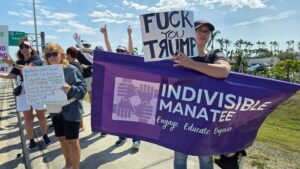 Fred Parmenter, the engineer, had been to a meeting sponsored by the local chapter of Indivisible, the national group organizing resistance. They offered 15 ways to get active in the movement, but not one of them involved listening, he observed.
Fred Parmenter: One of my characteristics is, I tend to be curious. If you tell me you’re excited about your stamp collection, right away, I want to sit down, and I’m just sort-of curious about that. I’ve been rather struck—and this probably applies to both sides of the aisle—but, boy, I’ll tell you, as I’ve gone around—and, mostly, we circulate with progressive people with the church we go to and the friends my wife has and so forth—I don’t hear much about being curious about why other adults feel quite differently.
GC: Parmenter mentioned David Brooks’ book, “How to Know a Person,” that actually gives tips on seeing and hearing others.
He worries what will happen after the next election.
FP: If one large group gets their message across and they win the next election and they’re very happy about that, what that means is that they and their friends are very happy—ecstatic—and they’ve gotten rid of a king, and they’re very happy about that, but what I’m concerned about—and, not a vent, Gretchen—is that leaves 150 million angry people.
GC: Chuck Lieberman is a financial advisor. He cannot afford to not know what is going on, so he paid close attention.
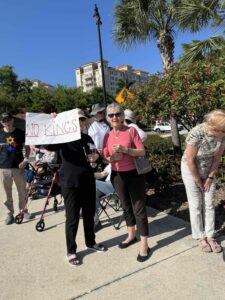
Photo by Sarah Hernandez
Chuck Lieberman: I think there needs to be more willingness to confront issues as opposed to just have conversations about them in a very conflict-avoiding way.
GC: He said that labels are part of the problem. But continuing to spin his thoughts, he talked about “Trump Derangement Syndrome”.
CL: Let’s start off with this label, “No Kings Day.” I see that as part of the problem. I see Democrats fighting with Republicans and willing to slander Republicans because a lot of Democrats suffer from Trump derangement syndrome. They oppose everything that Trump does, even when it means that they have to reverse their own positions from before he was in power—before he was President. So they’ve reversed course. It’s very popular in the liberal part of the Democratic party to literally oppose everything Trump wants because he wants it.
GC: Michael Bennett now lives in Plymouth Harbor, the upscale retirement community near St. Armand’s Circle. He’s the former Manatee County Supervisor of Elections and served 12 years as senator in the Florida legislature. He was overjoyed to see the participation.
Mike Bennett: I was excited about it. I think it’s great. I might not agree with everything that they’re protesting and the rest of it, but I’m an advocate of citizens’ involvement. I get so mad when you see an election come along and you’ve got 10% turnout, 20% turnout. Other than the Presidential election, which gets into the 80’s, people don’t give a damn.
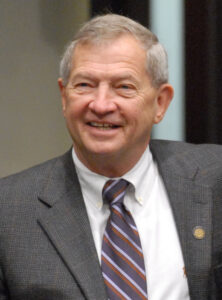
Mike Bennett
GC: Bennett doesn’t concur with all the president has done but gives low marks to Congress that he believes isn’t doing its job.
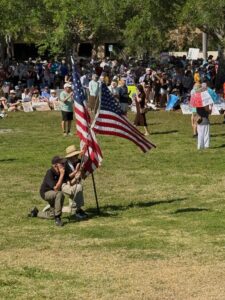
Photo by Klaus Obermeit
There is an organization here that is working to help people called CATA, an acronym for Conversations Across the Aisle. Bill Woodson founded it with a few others in 2023.
Bill Woodson: In the current environment where we’re so divided, people are, frankly, kind-of fearful of people who they disagree with ideologically. They’re afraid to open their mouth. They’re afraid to talk. We think this is toxic.
GC: Our founders created a pluralistic form of government for people with different ideas, Woodson said. So CATA hosts dinners programmed so that 3 progressives and 3 conservatives are at the same table, prompted to discuss specific issues such as immigration. Because our news media reaches for the extreme, we fear a discussion will dissolve into a heated argument, he said. But people can learn the skills to help navigate such discussions. CATA is part of the Braver Angels Network that is doing some of the same work.
Fred Parmenter, the mathematician, reminded us of those fears.
FP: When you put a sign out like that that says something about “Vote for Biden” or “Let’s arrest her,” I’m thinking, “What in the world good does that do?” Because if the person driving by is in favor of arresting Clinton, then they just feel that, and if somebody’s not in favor, that hasn’t done anything, and all you’ve done is irritate the people who are on the other side as they drive by your house.
GC: This is Gretchen Cochran for WSLR.
WSLR News aims to keep the local community informed with our 1/2 hour local news show, quarterly newspaper and social media feeds. The local news broadcast airs on Wednesdays and Fridays at 6pm.