Curators play a major role in the art we experience in museums, galleries and other public spaces.
From the January-March 2026 issue of Critical Times. Print versions are available for free at WSLR+Fogartyville and other community gathering spaces in Sarasota and Manatee counties.
By Kathleen Murray
How curators choose whose work—and what work—to exhibit, and how they present that work affects greatly the impact on both artist and viewer.
To understand better the perspective of local curators, Critical Times spoke with Lacie Barbour, associate curator of exhibitions at Sarasota Art Museum; Marianne Chapel Junker, founding director of SPAACES; Yoleidy Rosario-Hernandez, artistic director of Mosaic Movements; Christopher Jones, the Stanton B. And Nancy W. Kaplan Curator of Photography and Media Arts at The Ringling; and Mara Torres, director of MARA Art Studio+Gallery. (Interviews were lightly edited for space and clarity.)
CT: How are you approaching your curatorial practice in 2026 and beyond?
Lacie Barbour: My curatorial practice is really grounded in collaboration. I’m interested in working directly with living artists from a range of backgrounds, listening to their ideas for creating and presenting their work, empowering them, and helping to bring their visions to life. It is important to me to work closely with artists, curators, across departments, and our community to better understand what feels meaningful, accessible, and exciting for our audiences. I have a lot to learn, and that drives me forward.
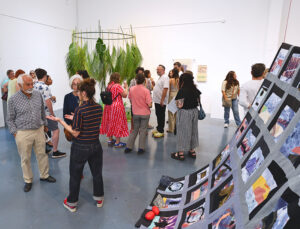
CARE: Givers and Receivers at SPAACES from April 19 through July 5 2025
Marianne Chapel Junker: At SPAACES, we are focused on curating exhibitions that center career-driven artists who prioritize process and ideas and are dedicated to their practice. The work begins with research, meaning, and inquiry—it’s important to us that materials and aesthetics serve the concept rather than lead it.
Yoleidy Rosario-Hernandez: My curatorial practice is rooted in community-centered, relational, and experimental curation. I’m prioritizing processes that honor artists’ lived experiences, challenge extractive models, and create space for collective authorship. Mosaic Movements is leaning into cross-disciplinary storytelling, decolonial frameworks, and experimental approaches that allow artists—especially those who haven’t yet had opportunities to share their work—to create, take risks, and present work in ways that feel culturally grounded and liberatory.
Christopher Jones: For me, it feels like society is at a moment of transition, if not upheaval, with so many powerful forces converging like technology and AI, the impact of climate change, and the fracturing of the traditional political order makes it feel like we’re at a real inflection point, and culture seems to be even more of a contested space. The future feels very uncertain for us all. I think it’s an important time to turn to artists to help us give expression to our experiences right now and find new ways to think through a challenging world. I’m looking for ways to help artists and audiences connect that emphasizes our shared humanity and create experiences that feel genuine, authentic and complex. Curators are always looking for new stories to share, but at a moment when thinking about the future feels so fraught, I think it’s important to connect with history and tradition, especially highlighting Indigenous and communities of color, and those marginalized. I’m also interested in artists who rethink our engagement with technology, blending traditional and digital experiences, deconstructing the algorithms.
Torres: I’m curating with intention and responsibility. My focus is on bringing diverse cultural voices into Sarasota—artists whose work reflects different histories, identities and cultures. I want exhibitions that feel thoughtful, global and relevant, while still maintaining strong conceptual standards.
CT: What are your sources for identifying emerging artists whose work is ready (perhaps with some mentorship) for an exhibition?
Barbour: I’m often drawn to artists who tell personal stories that open up new ways of seeing our shared world. I think the best way is to view an artist’s body of work in person, and in their studio, if possible. It helps me understand their consistency, scope, evolution, and their openness in having a back-and-forth dialogue when it comes to presenting their works. I keep this in mind as I’m going to art fairs, such as NADA in Miami, and visiting galleries and museums locally and nationally. Word of mouth is also really valuable, especially through different networks and colleagues. Social media is another way I like to keep up with artists and follow their practice over time.
Chapel Junker: I find artists by following MFA programs, regional prize winners, peer recommendations, and alternative or artist-run spaces. We often plan exhibitions up to two years in advance and work closely with artists throughout the process. Our review begins with artist statements to identify research-based, conceptually driven practices and cohesive bodies of work with clear themes. We also assess websites and portfolios and consider professional readiness, including communication, administrative reliability, and a high level of craft.
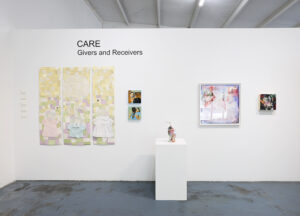
CARE: Givers and Receivers at SPAACES from April 19 through July 5 2025
Rosario-Hernandez: I find emerging artists through community networks, grassroots arts spaces, art events and programs, open studios, social media, and word-of-mouth within cultural worker circles. Much of our discovery also happens organically through Mosaic Movements’ Casa Caney gatherings, artist development workshops, and collaborations with local and regional organizers. Our organization is intentional about curating spaces where artists can connect with us, share their work, and build relationships. Some of the work we encounter is ready, some is still developing, and some has been collecting dust in a closet or storage unit — but all of it holds potential when artists are supported and affirmed.
Jones: All curators have galleries that they follow or have relationships with, and that’s one way we discover emerging artists, as well as networking with other curators and trying to get out to as many exhibitions and even art fairs, and, of course, following arts media. Staying connected to our regional art schools is incredibly important as we have so many talented young artists in the area and great programs and faculty to nurture them. Our ongoing Skyway project is another fantastic way for us to learn about emerging artists in our community. It’s a triennial collaboration with other leading art museums in the area and typically involves an open call for artists to submit proposals. We are already planning for the next iteration in 2027. It’s a phenomenal way for us to support our local artists and highlight the world-class contemporary art being made here in Sarasota and the greater Tampa Bay region.
Torres: I identify artists through ongoing research, trusted recommendations, and a structured direct submission process through the gallery’s website. Social media has become an important discovery and research tool. I prioritize artists whose work demonstrates conceptual strength, consistency and professional readiness, and who are receptive to curatorial guidance and long-term development.
CT: How is the way art is presented and experienced evolving?
Barbour: A large part of the conversation about the future of art seems to be focused on technology (and AI), but from what I’ve gathered, our audiences are really looking for deeper, more immersive forms of engagement, experiences that allow them to interact and form a relationship with the work, rather than simply observe it. I also think the ideas people are interested in shift with the cultural moment. In a world that feels complex and intense, there is a desire to engage with art that offers positivity, joy, and connection. For me, the challenge and opportunity is to balance that sense of comfort with exhibitions that still ask questions and expand people’s perspectives in thought-provoking ways.
Chapel-Junker: Art is increasingly experienced as something lived rather than simply viewed. I prioritize thematic and contextual curation, moving beyond purely visual presentation toward more experiential formats. While the work we present can be visually compelling and decorative, meaning, dialogue, and shared inquiry are central to the experience we aim to create.
Rosario-Hernandez: Art experiences are becoming more immersive, participatory, interdisciplinary, and communal. Audiences are seeking work that invites reflection, conversation, and embodiment rather than passive viewing. There’s also a strong shift toward hybrid and accessible formats — integrating performance, storytelling, digital media, and community dialogue.
At the same time, artists and audiences are increasingly curious about the creative process itself. The question of how an artwork comes into being remains compelling, even when that process stays behind the scenes. Many are redefining what it means to share, witness, and engage in an unfolding artistic journey—sometimes finding the evolution of the work more powerful than its final form. Still, not all artists work this way; some need privacy and intimate distance to create, and those boundaries must be honored. Overall, art is being experienced in ways that feel alive, relevant, and deeply connected across disciplines.
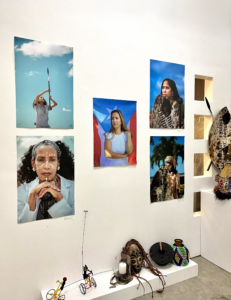
Warriors of Sarasota at MARA Art Studio + Gallery in 2022
Jones: I think there’s more emphasis on creating a unique and authentic experience, something that feels immersive and transportive. We are so bombarded with content and social media that I think we come to museums now to feel like a human being in a body in the world, so emphasizing our embodied senses and offering an opportunity to reconnect with ourselves is crucial. As museums, we constantly have to ask ourselves what visitors can experience here that they couldn’t on their phone, at home, or anywhere else.
Torres: The way art is presented is shifting toward immersive and emotionally driven experiences. One of my central goals as a curator is for the viewer to feel something—regardless of background, familiarity with contemporary art, or prior knowledge. Exhibitions are increasingly designed to invite presence and immersion, allowing the work to resonate on a human level while remaining grounded conceptual intent.
CT: What do you think has been the most impactful recent exhibition at your institution and/or that you curated and why?
Barbour: I say this sincerely–it is impossible to choose just one! Future Now: Virtual Sneakers to Cutting-Edge Kicks was amazing for students and younger visitors interested in the intersection of art, design, and fashion, and it brought entirely new audiences into the museum. The Art Deco exhibition has opened the doors to the future of modern art exhibitions at SAM. And it was incredible to see so many positive responses to Lillian Blades’ first solo museum exhibition, Through the Veil, with many visitors coming back again and again to immerse themselves in her installations. Our goal is for each exhibition to leave a lasting impact on our visitors in a different way, and we’re excited to continue building a program where there is something for everyone to enjoy.
Chapel-Junker: While all of our exhibitions feel impactful, CARE: Givers and Receivers stands out. The exhibition brought together nine artists from across the Southeast, representing four states, working across paper, porcelain, fiber, and installation to explore the emotional and physical labor of care. The work was exceptionally crafted and deeply personal, with artists sharing experiences that resonated widely. The exhibition fostered compassion, empathy, and understanding, and sparked thoughtful conversations between artists and audiences throughout its run.
Rosario-Hernandez: Many of the exhibitions that have moved me most were created by others, but if I were to highlight one from my own facilitation, Warriors of Sarasota (at MARA Art Studio + Gallery) would be the one. Curating this exhibition reminded me of the extraordinary stories that already live within our own communities. It centered the voices and experiences of incredible women of color in Sarasota whose brilliance, leadership, and resilience often go unseen.
The process was deeply intergenerational, and I had the privilege of listening to and learning from women across different stages of life. It was moving to witness how the themes, narratives, and relationships wove themselves together—and just as powerful to see the community members who showed up to support it.
In many ways, Warriors of Sarasota became a turning point for me. The experience was one of the influences that led me to formally start Mosaic Movements, reinforcing the importance of creating ongoing spaces where our local stories can be honored, uplifted, and shared.
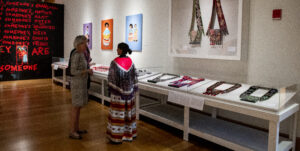
Reclaiming Home at The Ringling Museum in 2023
Jones: Our 2023 exhibition Reclaiming Home by my colleague, Ringling contemporary and modern curator Ola Wlusek, was the most impactful in my opinion. It was our first meaningful connection with contemporary artists in the Seminole and Miccosukee communities and one of the only projects to present contemporary artists from these communities and with a scholarly catalog. It was an important opportunity for our visitors to connect with Indigenous artists rooted in Florida who have endured and still preserve ancestral knowledge and preserve traditions while living in the same modern world we all share. It was a real honor for us to work with these communities and a turning point for the institution that represents Florida.
Torres: Small Talk, Julia Rivera’s solo exhibition, was especially impactful because it brought an internationally exhibiting artist to Sarasota whose work directly engages with human rights, women’s rights and climate change. Presenting an artist with a global exhibition history elevated the gallery’s program and expanded the local art conversation for collectors, reinforcing the role of the gallery as a platform for emotionally powerful, socially engaged and conceptually driven contemporary art. Small Talk generated sustained engagement, expanded the gallery’s collector base, and reinforced the gallery’s role in Sarasota, as a space for serious contemporary art that challenges and expands regional perspectives.
–Kathleen Murray is editor of Critical Times and hosts ArtBeat on alternating Mondays at 9 a.m.
If you go
- What: “In Our Own Backyard,” group exhibition curated by Mosaic Movements
- When: January 15-February 28; reception on Tuesday, Feb. 10, 5:30-6:30 p.m.
- Where: Fogartyville, 525 Kumquat Court
- About: Exhibition centers stories, creative practices, lived experiences that already exist within our local communities
- More information: mosaicmovements.org