The Sarasota World Affairs Council will host Patrick Duddy at New College this Thursday.
By Johannes Werner
Original Air Date: December 3, 2025
Host: Patrick Duddy is a close observer of the drama unfolding off the coasts—so far—of Venezuela and Colombia. The former U.S. ambassador to Caracas is in Sarasota to share his insights at a World Affairs Council event Thursday night. WSLR News talked to him by phone ahead of his talk.
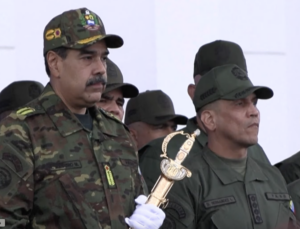
Johannes Werner: There’s saber-rattling around Venezuela. On the one side is the Trump administration, which has staged the biggest military buildup in this hemisphere in at least 40 years. It has blown up 10 boats suspected of carrying drugs and even killed survivors clinging to debris. It has declared a Venezuelan cartel—that some doubt even exists—a terrorist organization. On the other side is Venezuela’s unpopular president. Nicolás Maduro has been clinging to power, even after what looks like a clear election loss last year. That’s in part thanks to the Venezuelan armed forces that—so far—seem to stick to him. This week, he responded to Trump’s sabre-rattling by wielding the sword of historic hero Simón Bolívar, vowing he will fight back if the United States attacks Venezuela.
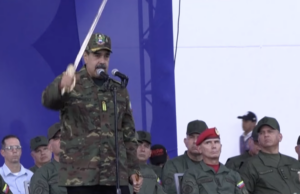
Maduro holds Bolívar’s sword, addressing a crowd in Caracas.
That’s quite the mountain Trump has climbed. Is there a way down, or will this escalate first?
We tried to find out from Patrick Duddy. He was the U.S. ambassador in Venezuela under two presidents. He was expelled by the Venezuelan government under Bush Jr. and returned to Caracas under Obama. Now he is retired and teaches at Duke University.
The Trump administration has so far been reluctant to engage in actual warfare. We asked Duddy what the intent seems to be behind sending the big fleet, including aircraft carrier Gerald Ford.
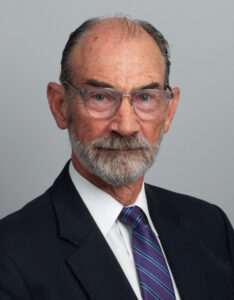
Patrick Duddy
Patrick Duddy: I think that, on the one hand, dealing with the drug problem is incredibly important to the administration. This particular effort comes about in part out of frustration; nothing else that we or others have done either unilaterally or collectively has so far worked. Now, that said, the size or the scope of the deployment in the Caribbean, I believe, appears to most analysts to be significantly too large or bigger than would be necessary if we were only thinking about stopping the maritime traffic through the Caribbean. So, again, the scope of that—a dozen Navy ships, thousands of sailors and Marines, the deployment of multiple aircraft, and now the aircraft carrier Gerald Ford—suggests an agenda that is significantly bigger than simply stopping maritime traffic. How can we possibly think otherwise?
The administration has never said that regime change is their goal, to the best of my knowledge. But President Trump has said that, in due course, we will begin to address traffic by land and air. What that will look like, I’m not entirely sure, in terms of the worst possible or the most kinetic outcome, we appear to be postured appropriately for an air campaign, perhaps with some ancillary activities, but not an all-out invasion and occupation of the country.
 JW: What about blowing up civilian boats and killing survivors—is this in any way justifiable under international law and the United States’ own rules of engagement?
PD: I’m neither entirely comfortable with it nor entirely uncomfortable with it, in part because I believe acting forcefully against drug traffickers is legitimate. If you accept the premise that they are essentially terrorists and therefore a threat to the United States—something, by the way, which the Obama administration declared in 2015 when they declared Venezuela a national security threat in 2015. That was the Obama administration. So this take on Venezuela as an epicenter for the drug trade and also a place where other malign actors are organizing is not new and does not date from this administration. So I’m fairly cautious because I want to see how all of this plays out.
JW: What If nothing changes in Caracas? Duddy does not believe this will come at a great cost to the Trump Administration or the United States.
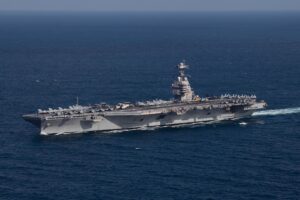
The USS Gerald Ford
PD: Within the region—I found this very interesting, because as a longtime diplomat in Latin America, I’ve always had the sense that any use of force by the United States would be roundly, soundly and immediately rejected by virtually everyone in the region, but not in this case. The Dominican Republic and Trinidad and Tobago are already fully cooperating with the United States, allowing us to use facilities in those countries. Grenada is apparently considering it, and Guyana clearly has a serious problem with Venezuela because the Venezuelans have essentially asserted that more than 50 percent of Guyana’s territory belongs to Venezuela. Much of the rest of the region is contending with this immense diaspora of Venezuelans—the refugee population, which has apparently reached approximately 8 million.
JW: And then, there’s Colombia. Venezuela’s neighbor has emerged from decades of chaos and violence over the last—relatively peaceful—two decades or so, with a lively back and forth between conservative and leftist governments and a robust judiciary. But now, the Trump administration seems to be dragging Colombia into what could become a wider conflict. Duddy seems more concerned about drugs coming out of Colombia than about political stability in that country.
PD: As we talk about this, while acknowledging the enormous progress that Colombia has made in recent years in consolidating its democracy, it’s also noteworthy that coca cultivation is once again surging in Colombia, and I think this has very much worried the administration. As I say, we have been partners, and the partnership at the moment appears fractured but not entirely broken. I would certainly hope that both we and the Colombians work to find a way back to full cooperation.
JW: Duddy will be speaking Thursday, December 4 as a guest of the Sarasota World Affairs Council. The event begins 6:30 p.m. at New College’s Sainer Pavilion. To make sure seats are available, you have to reserve by sending an email to info@sarasotawac.org. More information on their website at sarasotawac.org.
Reporting for WSLR News, Johannes Werner.
WSLR News aims to keep the local community informed with our 1/2 hour local news show, quarterly newspaper and social media feeds. The local news broadcast airs on Wednesdays and Fridays at 6pm.
 It's drive week!
Your gift keeps 96.5 on the air. Be one of the people who make it happen.
Donate Now
It's drive week!
Your gift keeps 96.5 on the air. Be one of the people who make it happen.
Donate Now