The county is making plans for Lemon Bay watershed improvements, to minimize flood damage in Venice, Englewood.
By Ifhmalee Caceuis
Original Air Date: June 26, 2026
Host: Flooding is on everyone’s mind. Sarasota County is trying to figure out how to reduce the damage next time around, and it needs your help. WSLR News reporter Ifhmalee Caceuis was at a workshop.
Ifhmalee Caceuis: When Hurricane Ian swept through Southwest Florida in 2022, it left widespread damage across the Venice, Englewood and North Port areas. Venice saw nearly 18 inches of rain fall in just one hour. Roads became impassable, mobile home parks and single family homes flooded, trees and power lines were brought down, and many residents were left without power or cell service. Two years later, Hurricane Milton again flooded low-lying coastal communities, highlighting the region’s vulnerability to severe storms.
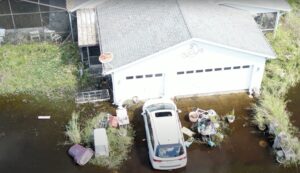 As communities continue recovering from those storms, Sarasota County and its partners are working to answer a very difficult question: How can future flooding be reduced before the next major storm?
That question was the focus of a recent virtual community workshop on the Lemon Bay Watershed Management Plan. The planning effort is being led by Sarasota County with support from engineering firms, environmental consultants and community organizations.
Jennifer Shafer of Shafer Consulting presented the two-day workshop. She emphasized the importance of participation and input from residents.
Shafer said residents, neighborhood associates, nonprofits and local agencies provide valuable information that technical models alone cannot capture. Their firsthand knowledge of recurring flooding, neighborhood conditions and local concerns helps planners better understand existing problems and shape future recommendations.
The most challenging areas are urban centers.

Jennifer Shafer
Jennifer Shafer: For urbanized areas that are already built and fairly dense, it’s very, very challenging to go back and retrofit—to go back and solve problems that were decades in the making. The flooding issues can be serious, and the water quality issues can be serious, and everyone agrees that they need a solution, but those solutions are very difficult.
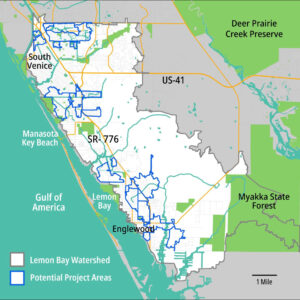
IC: The Lemon Bay watershed stretches from South Venice to Englewood. The original watershed management plan was developed in 2010. But it has been updated over the years as conditions have changed. The current update combines new information about the amount of water entering the system and where it’s going with flood complaints, elevation data, documented flood losses and community input. The idea: Identify where flooding and water quality problems exist today and where future improvements may have the greatest impact.
A lot of attention has recently focused on stormwater system maintenance—clogged pipes and ditches and breached dams. However, planners emphasized that this effort is evaluating whether existing stormwater systems perform as they were originally designed, not whether those systems have been properly maintained. Also, the assessment does not include storm surge flooding.
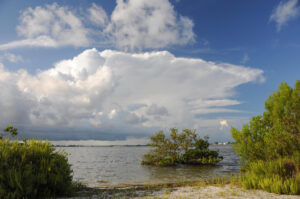
Lemon Bay. Photo courtesy of Sarasota County
Instead, engineers are looking at where the current drainage system no longer meets the county’s flood protection level of service. Under that standard, structures should remain free from flooding during a 100-year storm. Different roadway types must be built to withstand certain levels of floodwater. Neighborhood streets may temporarily flood with up to 12 inches of water, collector roads up to 9 inches, arterial roads up to 6 inches, while evacuation routes are expected to remain passable.
Using those standards, planners identified six potential project areas throughout the watershed, from South Venice to Englewood. One example discussed during the workshop was near Dragon Road in South Venice, where modeling indicates structures could be at risk during a 100-year storm. Scenic Drive was also identified as an area where flood depths could exceed a foot during a 10-year storm event.
 Beyond flooding, the county is also evaluating water quality concerns throughout the watershed. Officials are examining how land use, stormwater runoff, septic systems, irrigation practices and existing treatment systems contribute to pollution entering local waterways. They say future projects will prioritize locations that can improve both flood protection and water quality while making use of available county-owned land.
Shafer said she hopes residents leave the workshops understanding that solving flooding in already-developed communities is complex. Many neighborhoods were built decades ago, leaving little available land for new stormwater infrastructure. Because of those constraints, she said reducing future flood risk will require a combination of engineering projects, environmental improvements and actions by residents, businesses and community organizations to reduce pollution and improve how stormwater is managed.
JS: If there’s no extra space to, for example, store the water or cleanse the water, all sorts of solutions need to be on the table, including the contributions from neighborhood associations, condo associations, businesses and residents themselves in minimizing their nutrient pollution footprint and trying to let water soak back into the ground whenever and wherever possible.
IC: This was the last of a series of workshops on the Lemon Bay Watershed Management update. If you want to provide input, or seek more information, email Robert Bresciani at rbrescia@scgov.net.
For WSLR News, this is Ifhmalee Caceuis.
WSLR News aims to keep the local community informed with our 1/2 hour local news show, quarterly newspaper and social media feeds. The local news broadcast airs on Wednesdays and Fridays at 6pm.
 It's drive week!
Your gift keeps 96.5 on the air. Be one of the people who make it happen.
Donate Now
It's drive week!
Your gift keeps 96.5 on the air. Be one of the people who make it happen.
Donate Now