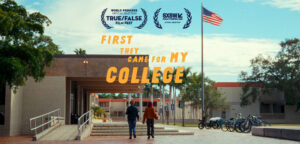
WSLR News interviews the makers of a new documentary film about New College.
By Brice Claypoole
Original Air Date: March 13, 2026
Host: A new film about the political takeover of New College of Florida just premiered at festivals in Missouri and Texas. WSLR News reporter Bryce Claypoole interviewed a producer and a director of ‘First They came for My College’ this week. Here’s his full interview with Harry Hanbury and Patrick Bresnan.
Brice Claypoole: Can you tell me each about yourself and what motivated you to decide to go into this project? Yeah, go ahead Harry.
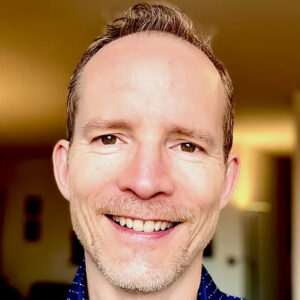
Harry Hanbury
Harry Hanbury: I’m an alum of New College. I’ve graduated with a degree in philosophy in sociology and went on to become a filmmaker and did a bunch of different work in film, a lot of investigative journalism work. And when the takeover happened, I was very concerned. And I felt like New College had sort of saved my life as a young queer kid, out of Catholic all-boys military high school, and I read the bios of the newly appointed trustees and saw the symbolism of their appointment on January 6th, 2023. I started talking to other alums and trying to see if we could find someone who could make a film. I found out about Holly Herrick, who runs the film program at Austin Film Society, and I heard that she was talking with filmmakers. Patrick is from Austin, had lived in Austin for many years. Holly put Patrick in touch with me, and I just was so grateful because Patrick was such a great fit for the project. He felt like a New College student, he presented like a New College student, and he understood the kind of the culture of New College really well. And so we dove in in April of 2023 and recorded a board of trustees meeting. And I’ll let Patrick take it from there about how we approached that.
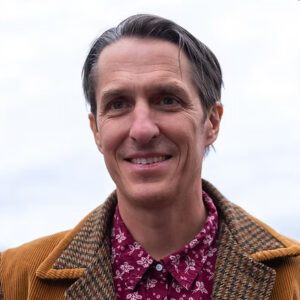
Patrick Bresnan
Patrick Bresnan: Sure. So my name’s Patrick Bresnan. I have made five films in Florida to date – two feature films: We made Pahokee. That was about a little sugar cane town right next to Lake Okeechobee, about the senior year of high school, and just how a hard-working class, parents, students and teachers – all the effort that goes into helping those students graduate and forge lives outside of Pahokee. The next film I made in Florida was about a struggling nudist resort in Loxahatchee called Naked Gardens. I have been to Sarasota numerous times. We’ve showed Pahokee at the Sarasota Film Festival. We showed The Rabbit Hunt at the Sarasota Film Festival. I loved visiting Sarasota, I loved watching the sunsets. I just find it such an interesting city. So I was approached in April by a very good friend of mine who’s an alum of the college, Holly Herrick, who also is the head of the Austin Film Society, where I went to graduate school, in Austin. And she said, ‘I have a shoot for you to go on’. I was really perplexed, I didn’t know about the situation at New College of Florida. She said, there’s going to be a hearing at my college and it’s understood that they’re going to deny tenure to five deserving faculty. She kind of went into the background of some of the other things that were happening at the college, and she needed me to go and shoot this board of trustees meeting. From that, maybe we would edit a sample and try and raise money to shoot more. So Harry met me in Florida. We drove to Sarasota together, we arrived on campus, and it was just Harry, and I could see how emotional he got. When he started pointing out various landmarks, like the antique car museum that used to be there, and instead of going to our Airbnb, I just thought, let me walk around the campus with Harry before we get into all the mechanics of making a film, and just feel through him what this place means. We walked toward Ham[ilton Center], which is the I.M. Pei-designed campus right next to the airport. Harry was just, at first, like ‘Wow, I can’t believe I’m here’. It had been so long since he had been there, and then he kind of knelt to the ground and started weeping because this place – I’ll let him talk – was so transformative to him. At that point, I knew I was someplace extremely special.
BC: Do you want to jump in there, Harry?
 HH: Yeah, just to elaborate on that story, as soon as we turned onto US 41 and I saw the PEI Dorms – I’ve been talking nonstop with Patrick for two hours on the drive from Orlando – and when I saw them, I just started sobbing. And then, when we got onto campus, I collected myself a little bit. But when we walked into Hamilton Center and I saw the GDC, the Gender and Diversity Center – I’ve never had this experience – I like literally, my knees went out from under me, and I just started sobbing because I think it represented so much hard work and achievement by queer and trans students, female students, everyone interested in diversity, students of color, to create that space. I didn’t even know that it was gonna be gutted – completely destroyed – not long after, by the junta, as I like to call them. But that’s what happened. I was so moved by that achievement, because when I was there, it was where the pool tables were. I actually liked to play pool, but I was just so happy and sad at the same time. That’s what New College was for me: A haven. I think for so many generations of young people in Florida, and I’m not even from Florida, but young people around the country, it has been a haven for bright, eccentric, self-motivated kids who often happen to be neurodivergent, gender divergent, sexually divergent from the norms in our society. And it was just really painful to see that attacked so callously.
BC: So can you tell me about the process of making the film, how you did that, and what it was like?
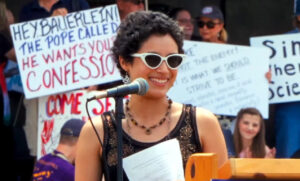
Editor in chief of The Catalyst during the making of the film: Gaby Batista. | Photos: Courtesy newcollegefilm.com
PB: Sure. For me it was a big news story, and there was so much happening that was newsworthy. But I wanted to make something that was very cinematic and very much in the voice of the students. So instead of having a big crew, sound people, tons of cameras, a very expensive production, we invested that money and taking the students out to eat in Sarasota. Because this was extremely traumatic, we needed them to participate in the film. They had experienced so much news reporters coming down for three days, chasing them around the cafeteria, chasing them around the campus, trying to get soundbites from them. And so we had to do something completely different. So every day that I was there, I made sure I had a meal with three or four students for lunch and dinner. We got to know them. My producers, Harry and Holly were very receptive to this idea that we had to give the students brand new or slightly used iPhones, to record their lives, to record what was happening on campus. This couldn’t be done with their phones because all of their phones had like 20 megabytes of storage on them, and we needed them to shoot for hours on a weekly basis. So that was kind of our founding principle, that we were going to invest in the students, put them first, give them space when they were overwhelmed with classwork or struggling, and be there as a friend to them. We wanted the film to be in their language.
BC: How did you choose from all of the resulting footage you that you got? What clips and what scenes went into the documentary?
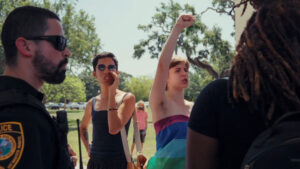
Trespassed: Libby Harrity (r.)
PB: Well, we had several things that were structurally foundational to the film: The board of trustees meetings, obviously, we see [college President] Pat Okker fired. We see professors denied tenure. We see a lot of big decisions being made that are very one-sided, and that conflict is also very cinematic and engaging for an audience. So we knew we had that. On an intimate level, we also needed tone for the film, and so Harry’s a journalist. We focused on The Catalyst student newspaper, because they were processing this in real time, and they were processing stories and things that were happening on campus that would never reach the major news organizations. So it was just another way to ground the film in the voice of the students, and show the importance of student journalism. We were also doing this because we wanted to culturally preserve The Catalyst. It was very obvious to people who were around that areas of study at the college were not going to be there in several years. So we really wanted to document The Catalyst so that it could reform, or the memory of how important student journalism is, could be preserved in the film.
BC: Harry, do you have anything to add there?
HH: I’m really heartened to see that the Old School Catalyst was created as a new independent organization by three former editors in chief of The Catalyst and Maria Vesperi, who was the faculty mentor of the official Catalyst for three decades. She is the advisor to that organization as well. So they’re keeping this important tradition of independent journalism going, but now independent of the school,
Host: If you just tuned in, you are listening to an interview with Harry Hanbury and Patrick Bresnan, producer and director of a documentary film on the political takeover of New College of Florida.
BC: So one of the threads in the documentary that I was fascinated by was the student named Joshua, who was a new student who came in with conservative views. Can you tell me a little bit about him and that aspect of the story?
PB: Absolutely. Very sadly, these films are expected to be 90 minutes long, and I would’ve loved to make a series or a three-hour movie. I had a lot of people who are mentors and advisors to me saying, ‘Don’t make this a one-sided film’, and I absolutely don’t want to make a one-sided film. So I worked really hard to get to know some of the baseball players and what they told me is, ‘We could lose our scholarships if we film anything with you.’ Several of them are like, ‘I’m just here for a year. I’m trying to get into UF or FSU. I thought I could study finance and business here. I just can’t help you’. I really respected that. So I really wasn’t able to film with any of the athletes, sadly to me. Then I started to hear about a very interesting conservative student who had written an article about his visit to New College. I saw him one day in a seminar, and he kind of looked like a professor. He had a mustache. He dressed in Brooks Brothers clothes, and he wore a trench coat, and he was always smoking, like right out of the XFiles.
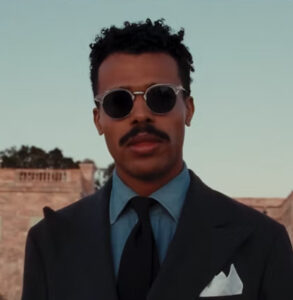
Joshua Janniere
BC: That’s exactly what I thought when I saw that one clip.
PB: Yeah. I was very intimidated because of his article, it was quite critical of New College. I went up to him and introduced myself and told him a little bit about the film, and he was the kindest, shy, sensitive, he had a great little smirk, and he kind of thought out loud by rubbing his mustache and smoking. And so I just said, ‘Hey, can we go have a coffee and breakfast together?’ We talked at breakfast. I kind of explained to him, ‘I think your feelings, your politics are really important, to you and to the story. And I’m not looking to make a one-sided film. Most of the footage we have of the other side is at these board of trustees meetings, and the administration, quite frankly, does not come off really well in those. And if I could follow your story, I’m happy to buy you a phone so that you can record your life and your experiences, I want all of that to be a part of the film’. And he looked at me and smiled and he said, ‘Sure’. And yeah, I feel like that was a huge breakthrough for the film because I love him to death and his bravery to show his conservatism, and then show how his feelings progress over the course of the two years that I filmed with him. It just takes remarkable courage. Yeah. And I think it makes the film much stronger.
BC: How did his views change? Or also for that matter, those of the people around him who got to hear his perspective?
PB: I’ll let Harry talk about this a little bit, but a lot of things in life and in film, they’re very gray. He didn’t go from being super conservative to being a member of a super liberal organization. He made friends at New College. He joined the theater. Many of the philosophy kids at New College – which is what he was, philosophy is part of his study – are the smartest kids you’ve ever sat at a table with. So he was just exposed to very rigorous debating, and not Charlie Kirk debating, debates about philosophy and being and politic. The college also awakened a side of him that loved movies. Before he had become conservative, his grandfather in Queens, who was also a professor, would take him to the movies all the time, and he started hanging out with the movie club and the theater kids and the philosophy kids. They were a lot more fun – and I’m not speaking for him – than a lot of the people he was meeting at conservative conferences. So these wonderful New College students opened up a new world to him.
BC: Harry, if you want to. Add anything. I do want to make sure I get to a few other questions before we wrap up here.
HH: Sure. I guess I just add that I spent a few days just now with Joshua at the True/False Film Festival, which was amazing. We screened in front of three audiences, about 300 people, then 330 people, then 1,200 people, and each time got standing ovations, or two standing ovations, which was just incredible. I got to meet Joshua and his best friend Calypso. I’d met them virtually, but he’s just a really great guy. Really smart. Speaks Latin and Greek. We geeked out talking about Plato’s Republic and The Symposium, and the PHUs, and what he’s writing his thesis on. I just found him to be a very open-minded and wonderful person. I don’t know all of the nuances of his transformation, but I think the big thing that really stuck with me was that he had been taught to sort of demonize people, and New College disabused him of that. He became friends with these people who are often portrayed as the enemy, the people who were destroying the culture. Queer people, trans people, free-spirited, freethinking people who are characteristic of New College for its whole history. So he’s on a journey as we all are, and it’s just really great to see him flowering, and I’m excited to see what films he makes.
Host: If you just tuned in, you are listening to an interview with Harry Hanbury and Patrick Bresnan, producer and director of a documentary film on the political takeover of New College of Florida.
BC: The opening quote in the movie, I believe it uses the term “christo-fascist” takeover, and the title of the film is also a reference to Nazi Germany. I know there are a lot of people who have been critical of using the term “fascist” for some of the modern day movements we’re seeing for things like taking over colleges. Why do you view this as fascist?
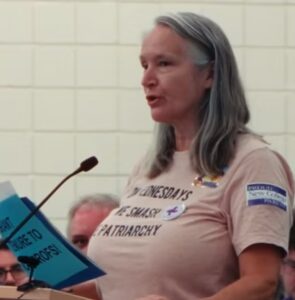
Amy Reid, former professor of French, now working for PEN America.
PB: Sure, I can speak to that. We recorded 300 hours, and I watched most of it. My wife watched most of it. Our other editor watched most of it. When I first arrived at New College, it was being characterized as fascism, and I was very hesitant to use that term for a year and a half. But going down to New College every week, every other week, seeing what I was seeing on the campus – the books thrown away, the utter chaos that almost every academic department was in, the utter chaos that the therapists who provide mental health work to the students, the utter chaos the student housing was in. And then the painting over of student murals, the removing of safe places for the students, the firing of the librarian, just the way that administrators were paying themselves and the president, the taking over of the New College Foundation. I saw so much that I can’t get into here that I felt, this is fascism. They are using their power limiting the self-expression of the students, of the professors, creating an environment of fear. I mean, teachers were in fear. And I have so much respect for the teachers who stayed at New College, because they stayed there to get their students out. They saw their students under incredible duress. To me, that is fascism. There was no democratic process at board of trustees meetings. They stacked the board.
BC: So the fear and the top-down institution of these changes is what you view as the fascist aspect of this …
PB: … and the harm that was done to students and teachers and their lives. It was purposeful harm. There was never… Richard Corcoran never apologized to a student. I never saw it that they had. Volunteer landscapers bulldozed, not bulldozed necessarily, but drove excavators all over a student food forest. That was a sacred place to that neighborhood next to New College, to the students, to the professors who used it as a classroom. They took things away from people without any process. They gutted the GDC when students were off campus. And this is terrifying.
Host: If you just tuned in. You are listening to an interview with Harry Hanbury and Patrick Bresnan, producer and director of a documentary film on the political takeover of New College of Florida.
BC: That brings us to what we’re seeing now, which a lot of people said back when this happened. ‘Well, what if this is a blueprint for national-scale changes?’ And that’s exactly what we’re seeing today. We’re seeing a huge crackdown on academic independence, efforts by the Trump administration to control colleges, and sort of bring them to heel as part of his agenda. What do you think of that, and what has having this experience at New College, almost seeing all of what’s now happening on the federal level, prior and on the smaller, more personal scale, what has that made you think?
HH: Yeah, I think that what was tried out at New College has metastasized all over the country. We see attacks on boards of trustees. We see attacks on accreditation. We see attacks on professors’ freedom to teach in the classroom, the freedom to learn, basically the idea or vision of education that is being sort of enforced by DeSantis and his cronies. He’s appointed this series of former Republican politicians to be the presidents of universities and given them the power to fire professors. So we have this top-down government constriction of what can be taught, which I think should horrify people across the political spectrum. Whether you’re a libertarian or a leftist or whatever, that’s a horrifying prospect. And I think, as goes higher education, so goes democracy. We see this in authoritarian regimes around the world. They attack universities because universities are a place where they experience some opposition, where people can discern the truth and think freely. Authoritarians don’t like that. Amy Reid, by the way, has a great report on this at PEN America – Censored Classrooms 2025, which just came out. It’s a report on the past year.
BC: So what are your hopes for, or your plans for distribution of the documentary and your hopes for what impact it’ll have and what people should take away from it?
PB: So right now we’re doing a very grassroots film festival run that will last about six months. Over that time period, we’ll be bringing the film to cities and film festivals across the country. We’re talking to a few distributors, and then they would take the film from there, and we would do kind of a more traditional theatrical run in pinpointed cities that are close to colleges. And then we will do, and Harry’s been working on this.
HH: We’ll have updates. We’ve been accepted to a whole bunch more film festivals, so we can’t announce those yet. But we’re excited to announce those very soon, and people can sign up, give us their email, and we’ll keep ’em up to date.
BC: Are there plans for screening it in Sarasota?
PB: Yes. We are not going to screen at the Sarasota Film Festival. The Sarasota Film Festival operates in partnership with the New College of Florida. There are several protagonists in our film, Libby Harrity, Tracy Farrow, who have been trespassed from the college. We will screen in Sarasota by renting a theater and finding a space that the producers and the New College community has agency over, and we’ll open that to the public. We just haven’t found the right time to do it.
BC: So that will be this spring? Is there any kind of timeline for that?
PB: We will probably do that in the fall, because so many people travel, and we want to show the film in Sarasota when the whole community is there, the snowbirds come down. We want everybody to see this film. We want everybody in Sarasota to know what happened at New College. So we are going to show this film most likely when peak winter season hits off. Patrick and I haven’t talked about this. Patrick, I just want you to know there’s a talk about an alumni gathering in May, so that’s another possibility, but that will be not open to the public.
BC: All right. So as a final question, I’ll ask both of you: What were the big takeaways for you going through this whole process, getting to know the students and recording this documentary, and what do you hope that viewers will take away from it?
PB: Well, I’ll say that education is a very sacred bond that happens between people who dedicate their lives to knowledge and sharing it, and young learners who are so excited to learn from these people to figure out their path in life. New College and other college campuses, they are a sacred space. It’s a space where someone like you who’s in their formative years – 18, 19, 20 – is finally out of the house and can go to a library and read about whatever they want. We need these spaces because we’re losing kids to things like TikTok and Instagram and monotonous video watching. These relationships between our young people and professors are what is going to save this country. And what happened at New College is a disgrace, because it had no respect for the sanctity of those relationships and what those professors have done for so many students, and how many lives they’ve saved, and how many lives they’ve shaped. So, I want us to look at this film and look back on this time and never do anything like this again.
BC: Okay. Harry,
HH: My quick takeaway is just that there is, can be, should be, joy in resistance. It’s been an amazing silver lining of this awful experience that I’ve been put in touch with so many amazing alums and other people who are upset by what’s going on. [New College Trustee] Chris Rufo and [President Richard] Corcoran talk about this as a blueprint for a takeover, but I think it’s also a blueprint for resistance. And the resistance at New College has made a huge difference that we’ve gotten to see up close and that the film portrays.
Host: You’ve listened to an interview with a producer and director of “First They Came For My College”, a new documentary about the political takeover of New College of Florida. For more information, go to newcollegefilm.com.
Coming up right now: The Progressive Page Turner, Marianne Barisonek interviews the author of a book titled “How We Win the Civil War”. Stay tuned.
WSLR News aims to keep the local community informed with our 1/2 hour local news show, quarterly newspaper and social media feeds. The local news broadcast airs on Wednesdays and Fridays at 6pm.