After re-emerging from bankruptcy, the non-profit continues to serve low-income patients.
By Dania Hefley
Original Air Date: December 10, 2025
Host: MCR Health provides healthcare services to more than 100,000 underinsured and low-income patients in Manatee, Sarasota and DeSoto counties. The non-profit re-emerged from bankruptcy this summer after layoffs and shedding a mental health program. Did these cutbacks affect patient services? And how stable is the post-bankruptcy MCR? WSLR News’ Dania Hefley asked the CEO.
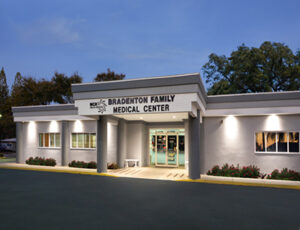
MCR walk-in clinic in Bradenton. All photos courtesy MCR
Dania Hefley: MCR Health filed for Chapter 11 bankruptcy in November last year. The nonprofit medical group blames Medicaid reimbursement cuts, a lawsuit and hurricane damage. In an interview with WSLR, MCR Health CEO and President Melvin Price confirmed the exit from the bankruptcy restructuring process.

Melvin Price
Melvin Price: We’ve been out since June. Our plan has been confirmed and we’ve been out.
DH: The decision to file for Chapter 11 came after a cascade of financial pressures. While aggressive Medicaid cuts to mental health service reimbursements were a factor, Price explained that the situation was more complex.
MP: That was a factor but not the whole. There was a series of events that led to that. We had major civil litigation going on; there was a change in our reimbursement from our government grantor; there were two hurricanes that hit at that time. So there was a multitude of events that cascaded us towards the chapter 11.
DH: Three years ago, former President and CEO Patrick Carnegie filed a breach-of-contract and state whistleblower lawsuit following his removal in November 2022. This litigation remains active and is being addressed within the company’s Chapter 11 bankruptcy proceedings.
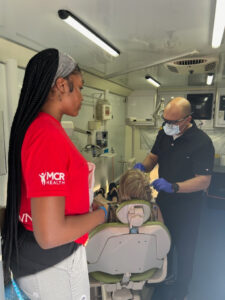
MCR provides healthcare services to more than 100,000 patients in Manatee, DeSoto and Sarasota Counties. Half of them live below the poverty line.
The bankruptcy filing cited factors such as substantial damage from hurricanes Helene and Milton, changes to behavioral health service reimbursement rates that nearly cut revenue in half and high inflation. The core purpose of the Chapter 11 filing was to cut mostly administrative jobs and eliminate duplication, Price says. He described it like this:
MP: It’s really just skinning down the organization to what we actually needed, and we just cut the excess.
DH: The restructuring process included workforce reductions. At the date of filing in November last year, MCR Health announced a mass layoff affecting 47 individuals across five locations. That was done by mid-December. The cuts affected various roles, with a particular focus on patient support services. The layoff notice shows that 34 of the 47 total cuts were to patient-facing support positions. An additional 10 administrative and technical roles lost included an X-Ray technician, an accountant, and a provider recruiter. But the job cuts went beyond administrative positions. They included three clinical roles—a physician and a nurse in orthopedics and a physician in pain management.
Did the job cuts have an impact on patient access?

MCR provides a broad range of services.
MP: Actually, those particular roles weren’t necessarily paramount to actual patient care. They were adjunct positions that help with patient coordination. That’s a bit different. The patient care and quality did not suffer at all. We did have a patient care ombudsman that the court appointed to make sure that quality did not suffer through the court proceedings and through the bankruptcy proceedings. He gave us a complete, clean bill of health. He found absolutely no indication of decrease in quality of care.
DH: A key part of MCR’s strategy to rightsize the organization involved the sale of its Huntingdon Behavioral Health practice. With this move, MCR explicitly sought to stem the losses it was incurring in its mental health services. The buyer, ACE Consultant, is expected to pay MCR two-and-half million dollars over five years and to take over all employees.
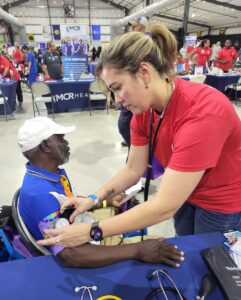
Health check during a recent fair in Arcadia.
Price told WSLR that mental health care remains a core part of MCR’s mission.
MP: We do have behavioral health as one of our lines of business. It is becoming more and more evident that behavioral health is needed in all age groups. We plan to meet that need with the providers that we have as far as building on top of that going forward.
DH: Price mentioned that MCR offers services for issues like depression and dependency. Regarding dependency issues, Price said:
MP: We don’t have an addictionologist, but people that are working through dependency of many sorts, we have services available for them so that they can get to a better place.
DH: We also asked Price how the immigration crackdown is affecting MCR’s operations.
Melvin Price: We have seen—especially in our migrant community—the hesitancy to come in for care. Some have just stopped coming altogether. Some are even telling us that they’re going to be leaving. The combination of all of that has really decreased the migrant population that we would normally serve.
 DH: He adds that the financial impact of the growing uncompensated care from this situation is “detrimental to our bottom line.”
Uncompensated care is the general term for healthcare services provided for which the hospital or clinic receives no payment. It includes both charity care, where the provider explicitly decides not to charge in-need patients, and bad debt, when patients fail to pay bills when they were expected to pay.
Price said that MCR is seeing more migrant patients who are uninsured or underinsured and are hesitant to seek care. When these patients eventually receive necessary care, MCR is subsidized less, and providing that care ultimately costs the organization more.
MCR Health’s leadership is now focused on strategic growth to ensure long-term sustainability. Price noted that the organization is ahead of its projected plan and anticipates future expansion.
MP: The purpose of the chapter 11—and, when anyone does chapter 11, so I’ve come to understand—is getting the organization in a better position to go forward. We are ahead of our projected plan assumptions. We just see growth going forward, and that would be strategic growth.

MCR Health in North Sarasota.
DH: Price explained that part of this strategy involves embracing innovation to streamline workflows and improve the patient experience.
MP: We are looking at innovation of all types to help with the workflow—especially with AI coming into its own right now in the healthcare business and in all businesses—to allow the doctor to spend more time with the patient and talk to the patient face to face while the AI generates a note in the background so that the doctor can just review it and actually spend more time with the patient as opposed to on the computer.
DH: Reporting for WSLR, Dania Hefley.
WSLR News aims to keep the local community informed with our 1/2 hour local news show, quarterly newspaper and social media feeds. The local news broadcast airs on Wednesdays and Fridays at 6pm.