As the EPA finalizes new rules, the future of these critical ecosystems in Florida is uncertain.
By Brice Claypoole
Original Air Date: February 11, 2026
Host: The Clean Water Act is one of America’s bedrock environmental laws. Since its enactment in 1972, different presidential administrations have interpreted the scope of its protections differently. Now the Trump Administration wants to remove protections from over 80% of wetlands under the act. WSLR’s Brice Claypoole explores what that means for Sarasota.
[Birdsong, footsteps on grass]
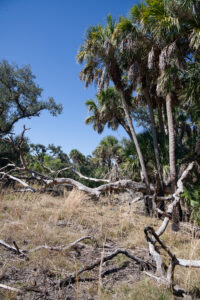
Photo by Brice Claypoole
Brice Claypoole: It’s a beautiful day at Myakka River State Park when Jono Miller and Julie Morris hop out of their car and trudge down towards the river bed. The two first visited Myakka over 50 years ago when they were college students. They’ve been coming here ever since. Miller served as chair of the Myakka River Management Coordinating Council in 2024.
The sun is shining, and after weeks of cold, the land is warming up. But one thing about the landscape instantly jumps out: Everything is bone-dry. Grass crackles beneath our feet, and the river is reduced to a narrow channel. This, Miller reads from an old study of Myakka, is part of the natural hydrology of the area.
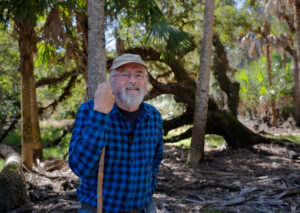
Jono Miller. Photo by Brice Claypoole
Jono Miller: Streams in the area ceased natural flows during at least five droughts. Many of these non-tidal reaches go virtually dry during the late spring of most years. It’s basically a river that’s driven entirely by rainfall. So there’ll be stretches where it’s completely dry and there’ll be deeper patches that may have fish or gators or whatever in them.
[Footsteps through mud]
BC: That’s exactly what we see: dozens of alligators and hundreds of birds lining the few deep areas of the shrunken river. It’s a vivid example of how Sarasota’s unique watershed fosters diverse ecosystems. But it’s that very same hydrology that has put the area in the center of a fierce debate over federal rules that protect waterways.
The conflict stems from the Clean Water Act, a 1972 law that regulates discharge of pollutants into waterways. It also protects surrounding wetlands that filter pollution. Presidential administrations’ interpretations of the Clean Water Act have been an exercise in regulatory whiplash for years, with Democrats expanding protections and Republicans shrinking them.

Photo by Brice Claypoole
Now, President Trump’s Environmental Protection Agency, or EPA, wants to gut them. The EPA recently released a proposal that would limit Clean Water Act protections to just 19% of U.S. wetlands. Some states could see protections evaporate for over 97% of wetlands, according to Politico’s E&E News, though numbers for Florida are not available.
At the core of the changes are new standards requiring that wetlands have continuous surface water connection to waterways at least during the “wet season,” to be protected. This interpretation is in line with a controversial 2023 Supreme Court decision that wetland protections could only be applied based on physical connection to waterways rather than on their ecological impacts like pollution reduction or wildlife habitat. It also said that waters need to be “relatively permanent” to receive protection.
That vague term is a key flashpoint. Environmentalists want “relatively permanent” to include as many wetlands as possible. Conservative groups and industry advocates want it to be extremely limited. By creating the “wet season” test, the Trump administration may not satisfy all industry advocates but puts itself firmly on their side. It also creates uncertainty about whether Sarasota’s sprawling seasonal wetlands like those at Myakka still have federal protection.
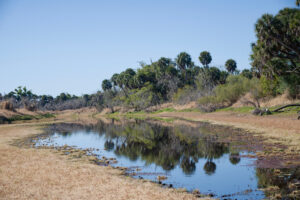
Only wetlands connected to a water current would be protected under a proposed EPA rule. Water hole during dry season in the Myakka River wetlands. Photo by Brice Claypoole
The decision to redefine which wetlands and waters are protected comes as the EPA under President Trump pursues what it calls “the biggest deregulation” agenda in U.S. history. It has been hailed by business leaders, from agriculture to development, for simplifying regulation.
In a statement to WSLR News, Jon Mast, President of the Suncoast Builders Association, praised the decision for limiting the scope of the Clean Water Act. He wrote, “the negative overreach by the former administration’s actions were punitive and needed to be changed.” At the same time, he said that the change won’t benefit local developers unless the EPA can start processing permits more quickly.
I also spoke with Daren Bakst, Director of the Center for Energy and Environment and Senior Fellow at the Competitive Enterprise Institute, a free-market think tank. Bakst supports the proposed rules, though he wants them to go even further.
Daren Bakst: What waters are regulated are considered to be relatively permanent waters, according to the court. And that really should mean waters that exist pretty much the entire year.
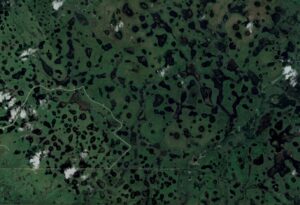
Water holes at Carlton Reserve just south of Myakka State Park. Photo: Google Earth
BC: Bakst believes the Trump Administration’s proposal simply brings regulation in line with the Supreme Court’s 2023 ruling. That doesn’t mean waters can’t be protected in other ways, he says; just that the federal government doesn’t have jurisdiction over them. He suggests state and local governments are closer and have a better handle of the issues. Bakst also emphasizes the harsh penalties land owners can face for violating the Clean Water Act.
DB: I think we also need to be concerned about the fact that innocent people wind up getting fined, potentially going to jail, not being able to actually develop their property. I’m not talking about like huge investments. We’re talking about building a house. How about America? How about the farmers of Florida? I think we should be concerned about them.
BC: Environmental groups, on the other hand, warn that the rollback could lead to widespread destruction of wetlands and increases in water pollution. And standing by the Myakka River, Miller points out why.
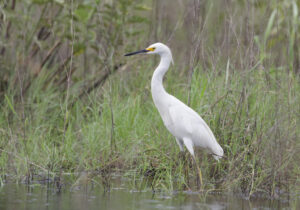
Photo by Brice Claypoole
[Birdsong]
BC: Wood storks, limpkins and stunning pink Roseate Spoonbills walked and squabbled on the banks, creating a scene full of motion and life. Despite this vibrance, the United Nations says that wetlands are being destroyed faster than any other ecosystem on Earth.
Dr. Stacy Woods, Research Director for Food and Environment at the Union of Concerned Scientists, explains the benefits wetlands provide.
Stacy Woods: Wetlands sustain an astonishing diversity of life. Wetlands also provide homes for over half of the commercially harvested fish and shellfish in the U.S. that live in wetlands for at least part of their lifecycle. And this means that wetlands are absolutely fundamental to the substantial U.S. commercial seafood industry. Additionally, we’ve got wetland trees and plants that can slow rushing water and further reduce flood risks to nearby communities.
BC: Woods says that if you add together the economic benefits for commercial fishing, water supply, water quality and recreation, wetlands provide trillions of dollars in benefits each year.
SW: And those benefits are all at risk with the proposed changes to the Clean Water Act.
BC: Sarasota wetlands may be particularly at risk. Many of our wetlands are depression marshes—shallow basins that fill up with water during parts of the year. Abbey Tyrna, a wetland scientist who serves as the executive director of Suncoast Waterkeeper, says that because for most of the year the wetlands aren’t connected by surface water to navigable waterways, they’ll be left unprotected.
Abbey Tyrna: Those are the vast majority of wetlands in the State of Florida and those are not connected on the surface. Basically, all of Myakka except for the two manmade lakes and the river would no longer be protected.
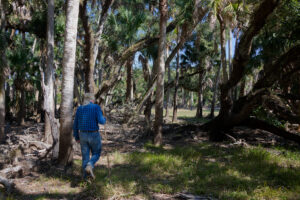
BC: At Myakka, Miller points one of these depression marshes out to me.
Jono Miller. Photo by Brice Claypoole
JM: There’s one up here.
[Footsteps over leaves]
BC: Right now, it looks like a clearing filled with dead grass. For a critical ecosystem, it looks pretty empty. But come summer, Miller says, it will be full of water and lush aquatic vegetation. In fact, were it summer, we’d be up to our shoulders in water.
JM: We’ve come out here when you could take a canoe through here.
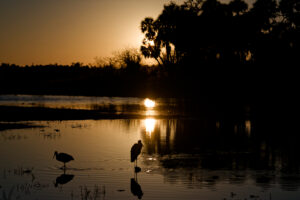
Photo by Brice Claypoole
BC: The thousands of depression marshes that dot Sarasota County support fish, birds and other life, Miller says. But they’re also important to one of Sarasota’s oldest industries.
JM: The presence of all these wetlands with grasses in them made for great cattle country, better than similar places. That’s part of why Sarasota has a reputation and why some of these ranches have survived despite development pressure.
BC: These wetlands have supported Sarasota’s economy for hundreds of years. The one we are looking out at now is protected by the state park. But for thousands of others, vanishing protections could now spell an uncertain future. As we stand in the shade of a towering live oak, I ask Miller what he feels about that.
JM: I think it’s very unfortunate that we’ve lost so many wetlands nationally, at the state level and even here in Sarasota. One would expect, with all these losses, that there would be an inclination to increase protection for what remains. Instead, we’re seeing a renewed attack.
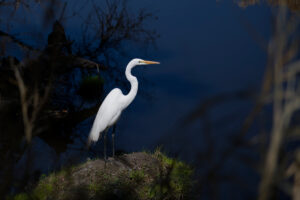
Photo by Brice Claypoole
BC: Roughly half of Florida’s wetlands have been destroyed already. As the EPA finalizes the new rules, the future of those that remain may well hang in the balance.
[Birdsong]
BC: For WSLR News, this is Brice Claypoole.
Host: Brice Claypoole is a board member of Suncoast Waterkeeper. He is not directly involved in the Waterkeeper Alliance’s opposition to the proposed rule changes. Jono Miller and Julie Morris host the “Our Changing Environment” show on WSLR.
WSLR News aims to keep the local community informed with our 1/2 hour local news show, quarterly newspaper and social media feeds. The local news broadcast airs on Wednesdays and Fridays at 6pm.