After moving her family from Bradenton to Minneapolis, Lul Kassim describes how ICE changed her daily life, and how she feels about her future.
Interviewer: Johannes Werner
Original Air Date: February 6, 2026
Host: You are listening to WSLR News and I am Johannes Werner. Last weekend, I talked to Lul Kassim, a nurse practitioner and immigrant from Somalia who moved from Bradenton to Minneapolis recently. Here’s the full-length interview, in which she shares her perspectives on how Operation Metro Surge has affected her life, and how she responds to the challenge.
I began by asking her about how she came to the United States.

Lul Kassim
Lul Kassim: I’m originally born and came from Somalia, East Africa. It’s at the Horn of Africa – a lot of people don’t know where that is. So my parents left Somalia first. We left in the middle of the night when the civil war started. We came to Kenya, which is the neighboring country.
And then from there … we were in refugee camp, and then, I think there was a refugee resettlement program that the Americans were involved in. So then my family were in that program. So then we settled, we came over to the United States.
Johannes Werner: You were a child?
LK: Yeah, I was a teenager. I was like, 14 or 13. I can’t remember.
It was like 1995. So that’s how we came to the United States.
JW: So you were a teenager. It’s 1995. Where did you first land in the United States?
LK: We first landed in JFK, New York. And from there we came to Maryland – not Baltimore, but Riverdale, Maryland.
There were a lot of refugees there – Bosnians, Vietnamese, from different countries, refugees from Iraq. We settled there. My parents started working in a factory. I think my mother worked in a Revlon factory, it’s like a makeup factory. And my father worked in some other factory, a meat factory. We were there for a while, and my sister had a friend in Minneapolis and said, ‘Look, you can get a better job here, so you should move here’. So my older sister moved here. Then slowly the family came along to settling in Minneapolis.
JW: You eventually became a U.S. citizen. How did that happen and when?
LK: Well, I think my parents first became U.S. citizens. It just automatically happened, I think, because when you’re a refugee, they give you this I-94 [visa] I think it’s called, and then they give you a green card within two years.
Then after that, my parents were in the process. After being in the country for five years, you are eligible to apply for citizenship, which they did. And then through them, if you are underage, through them, you became a citizen. So we all applied, and then – I really don’t remember the process – but then that’s how you get naturalized, and we became citizens.
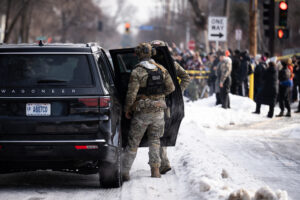
ICE agent in Minneapolis. Photo by Chad Davis via Wikimedia Commons
I never thought about, I never think about that. I don’t even remember most of it. It is just, it was a process that was going to happen, and it kind of happened. I’ve never gotten a passport until … we all got the naturalization certificate, but I never got any passport because we never traveled. I think the first time I got a passport must have been when I finished high school and maybe going on a school trip, or something somewhere. So I took the passport. But other than that, it really was just sort of, ‘This is our new country and you’re part of society’.
My parents mostly worked in a factory job. Most refugees work these non-skilled jobs that they worked. We went to school, my parents always say, ‘You need to get an education so you can do better than we did’. And so, that’s how life was.
JW: There was a stop in Florida. You had a life in Bradenton for a while.
LK: Yes. I met my husband back in 2013, and then we got married in late 2015, and in 2016 we lived for a little bit in Germany. He always didn’t like the cold in Minnesota, so we didn’t know where we were going to live. So we decided, ‘Okay, I said, well, I can compromise’. I’m not sure if I really like Florida or not, but he’s like, ‘Oh, you’re gonna like the weather, if nothing else’. So I was like, okay, fine. I guess I can like the weather. So I moved to Florida. I’m a nurse practitioner. So, I moved to Florida, I got a job there for four years, I think, from 2016 to 2020.
Mainly, we stayed in Bradenton. I worked in St. Petersburg, in the surrounding area, but mainly I stayed in Bradenton. When 2020 came, I had my first child and then, the first year after, 2021, my mother-in-law wanted to see the child. She was in Berlin, so we decided that, okay, maybe it’s better if we stay six months here and six months over there so she can be with the the baby.
So I have been doing that since. And then last year, my oldest daughter was old enough to go to school. So we are like, we have to make a decision. So then we decided to move out of Bradenton and to Minneapolis.
JW: And why was that? Why did you decide to move to Minneapolis, and what was your hope of finding in Minneapolis?
LK: Well, my dad was sick, and since then, he passed away. And a year before that, my mom passed away. And my oldest sister lives here. Most of my family live here. So that was one thing. It’s a little difficult to go to work and with small children. You also need the family support, babysitting and whatnot.

‘We the People’ – anti ICE protest in downtown Minneapolis last weekend. Photo by Balquisa Booker
So that was one. The other decision we came back is the education system. My husband is a German national, and he wanted the kids to able to speak German. That means, they go to German school, German immersion school. This is the other reason why we came back to Minneapolis. The school, the family.
JW: One step back. The experience of living in Bradenton, in Florida as an immigrant couple – do you have any specific observations of how that was for you?
LK: Experiencing living in Florida was a little bit different. If you have never been to the South of the United States, it’s quite different. People think differently. In the north, there are a lot more diverse groups here in Minnesota. There’s a larger East African community here, where in Florida there was none of that. And then, for the first time I saw the Confederate flag flying. That is a very strange thing to see ,because usually if you’re in the Minneapolis area, you never see the Confederate flag. No one has the Confederate flag or any other flag. I saw one time the Confederate flag with the Nazi flag, with the American flag in Florida, which was very confusing. You don’t see stuff like that. It’s very bizarre to see that. Yeah, so it was a little bit different.
Being an immigrant couple – my husband was always coming, going back and forth to Germany, because most of his income … he works in Berlin, he’s self-employed. So he comes and goes quite often. I don’t think for him it makes any difference. For me neither, to be honest, because mostly I worked, and if you’re a nurse, you work very odd shifts. I barely have time for like … I will go to the beach, the days I am off. Yes, people may ask odd questions here and then, especially when we are together. When we’re walking together, people may look at us a little longer, but nothing really out of the ordinary. You’ll get stares, that’s it. Here, no one cares. Nobody, nobody really looks at you.
JW: Living in Minneapolis – how has it been since you moved there before the ICE incursions?
LK: Oh, good. I was happy moving back home. I have old friends, old coworkers, and I was meeting up with them. I got a new job here, and we are very excited about my daughter’s new school, and of course my husband was very happy. There is some German institute. There’s a German Oktoberfest, and this culture, and he’s happy to be able to see other Germans, even though they’re from different regions than him. So we were happy, we would go to the park. Everything was very relaxed, we liked our new neighborhood. Our neighbors were nice. Kids would play outside. We’d go to the park all the time, to the zoo. So that was just normal life, nothing really significant. Yeah, it was normal.

Anti ICE protests in downtown Minneapolis last weekend. Photo by Balquisa Booker
JW: Then ICE came. Can you tell me how that changed your daily routines, your life?
LK: Yeah. I think it started when Trump decided that he would say something about that. I only heard a snippet of it because I don’t follow the news much. The first time I heard it, he said something about Somalians and they’re garbage. Then after that, I heard the announcement that there will be ICE here, a lot of ICE agents will come to Minneapolis. And I thought, oh, okay. I was confused what it is that they were looking for. I’m sure there are some undocumented immigrants here, but there’s not a lot. And I was thinking, most – the majority of Somalians, 90% – are U.S. citizens, and the other ones are legally here. There are a few, few and far between, that are undocumented. So I didn’t understand. I thought it was kind of odd. I was like, ‘Okay, we’ll see what happens’. Because a lot of times, it is one thing hearing it from the news, but another thing, if it’s reality. He says many things.
But when I knew they were here, I heard they were going into very concentrated areas, like Somali Mall and the Somali area, and they were getting really aggressive. And then the stories every time they grabbed a citizen. They didn’t know if he was a citizen, but they detained the citizen [anyway]. The first time I think it was a Somali 22-year-old, and he was a U.S. citizen. He came here when he was five or something. And that was odd, I thought this is really crazy. I mean, now they’re grabbing you as citizens. So that put me on alert. I said to my husband, ‘Well, you better have your passport with you when you go to the store’. So I start taking my passport with me all the time.
And then, more agents were coming. I went to the market one time, to Aldi, with my daughter, after I dropped off my oldest at school. There were a lot of odd people, like a group of people all dressed up and going in a group. I just thought, oh, maybe they’re construction workers who dressed funny and they’re just getting stuff. Sometimes, the fire department shops at Aldi. And then I came outside to the parking lot, and there’s another Somali lady. She came towards me and she said, ‘Have you seen them?’ I said, ‘Who?’ ‘ICE’. And she said they were ICE. And I said, oh, okay. So they were going in, obviously they were not … they just kept lurking there. So I just put all my stuff [in the car], I went home, and then I’m hearing all these stories from the neighbors. Oh, they were in Walmart, they were at Target. They’re, you know, at the Friday prayer, when people go to the mosque, they’re surrounding the mosque, and it has become a bit noticeable. Then in our neighborhood, there is an apartment complex, and there is University of St. Thomas, St. Catherine. There’s a lot of universities here and international students. So of course they start to lurk around here then. They’re everywhere, basically. You can’t avoid them. You see them. So now it’s like, okay, you really don’t wanna go outside unless you absolutely need to go outside. Even the gas station, I make sure – now my husband is here – he comes with me to go to the gas station. It’s such a planning, it’s such a planning you have to do because you really have to be careful.
JW: Do you feel that the Somali immigrant community in Minneapolis is a major target for ICE?
LK: Yes. Yes. We, we feel like we are being watched, and we’re major target. The other thing is that they’re not stopping anybody else. They’re only stopping people who look like me or people who are Latino looking or Asian. It’s like assuming everybody else is illegal or an immigrant. They arrested a U.S. citizen born here, a Somali U.S. citizen along with an indigenous native. I don’t know which one of the tribes, I don’t know if the Dakota tribe, the Ojibwe tribe. And the tribe members have to go and prove, to show her card that she is indigenous.
So there goes to show you, they don’t care about anything. They’re not looking for anything. They’re not asking the proper people. They’re just grabbing people. And the other thing I’m hearing from the neighbors here is, they’re saying to people, ‘Oh, you know, we killed already one, one or two of you. We can do it again.’ So the agents are saying that to people. So then that even increased my paranoia. Now I’m paranoid. Everybody is terrified. They can kill you, and nothing will happen to them. And then the police can’t do anything about it. Even if you were to call the police, they just will tell you, ‘There’s nothing we can do. You need to cooperate with them.’

Anti ICE protest in downtown Minneapolis last weekend. Photo by Balquisa Booker
JW: Have you been close to, or participated in any of the protests?
LK: Yeah, I went to a vigil for Alex [Pretti], we had a vigil here in the neighborhood. But also I went, I stopped by where he was murdered. And there was a lot of people there, putting flowers and candles, but they were not present when I was there. But sometimes when there’s a protest, [ICE agents] show up. It’s almost like they like the confrontation. I don’t usually go to protests, mainly because I have two little kids and I’m working, and I’m not someone who goes out and protests all the time.
JW: There’s a weird reversal. Minneapolis is the place where George Floyd was killed by local police, and it was the feds who came to help fix the mess. Now it’s federal agents in the city that are a big concern for you. How do you relate to local law enforcement and local police? Has there been a change?
LK: I think what’s happening is the local police, they just, they don’t know what to do. They’re getting called because people are afraid of ICE, or they’re coming in during protests, try to direct people, try to calm people down. However, in terms of, if you were to call them, I don’t think, I don’t know how much they can do. They cannot stop a federal agent. They can just tell you, ‘They have to have a warrant in order for them to get into your house. You don’t need to open the house for that.’ But the problem with that is that sometimes, they break into your house and, and show … they have like the warrant that is signed not by a judge, but an ICE patrol agent. My niece was telling me that is not a warrant. So if they ever come to your house for whatever reason and they show you that, that is not a warrant. It has to be signed by judge. People are getting education about their rights. If they stop you, how to interact with them, try to stay calm. It’s easier if you just show them your passport so they can let you go. So everybody is saying, have your passport on you, if you can – your passport or other ID. Have your driver license on you. But the other thing they’re doing is, they’re pulling over people for traffic stops, which is not their job. That’s the law enforcement’s job. So then it’s like, now you’re paranoid even driving because they’re just gonna pull you over. I have cut down, I would say 75% of all my activities.
JW: Tell us a little more in detail. You’re one busy person – you work, you are a mother. Tell us how you organize your day and what’s different now.
LK: Usually I go to work Monday to Thursday. I work only Monday to Thursday from eight to four. In the morning, we, I usually get up if my husband is here, he gets the girls ready. If he’s not in – sometimes he’s in Germany – I would get up very early in the morning, like around six, take my daughter, get her ready, and then drop her off at school. They have an early program, so I drop her off. Then from school, I go to work, and then after school, after work, I pick her up, and then after that I take her to swimming class, martial arts, or other activities, or play at the indoor playground, if possible. We have so much to do. And then, we go home for dinner, we may even go stop by at the market. That’s our daily routine. I’m always busy.
I’m dropping them off. but then sometimes, if I’m late at work, my sister may pick her up, and then she would be at my sister’s house. So I will pick her up from there. Usually the weekends, we have many, many programs. We have play dates, we are always at someone’s birthday, or going somewhere, or have other activities like going to the museum and stuff like that, or ice skating.
But now we don’t do any of that. So now at school, papa picks you up, brings you back home. I come directly from work home. I don’t stop by anything. I don’t go anywhere. Even the smallest thing is calculated, so whatever we need, we have to get it one time and just stay at the house. Last Monday, I didn’t go to work. I told my job if I can just do things virtually, which they allow me to do, because last Monday, last weekend is when Alex [Pretti] was murdered, and they were very aggressive. So they were very present. They’re lurking around everywhere. They were lurking around where I work, which is 20 minutes from here, Woodbury, and it wasn’t safe for me to go to work. So then I just sort of decided, whether I work from home, which I did. My job is very supportive of others. She said, they told me, ‘If you feel unsafe, or if you feel like there is so much presence of them, you can just stay home.’ So that has been very helpful.
Yeah. I mean, like today it’s very nice day, sunny day. Usually we walk to the library, me and the girls, and do things. Now, we just stay home, and I don’t tell the kids why we’re staying home. I just tell them, ‘It’s too cold, why don’t you play here, or whatever?’ Because they’re five and three, I don’t want them to be afraid or to be aware of this thing going on. I try to shield them from that.
JW: Are you always carrying ID, passport now?
LK: Yes. We all carry passport. My husband carries passport. I carry passport. The girls’ passports are in there now, nominally,
JW: Your husband is not a U.S. citizen, right?
LK: No, he is a German citizen. He has the visa to come in all the time. He never has a problem, but now he has to carry his passport.
JW: How do you feel about this? I mean, nominally he’s the more vulnerable of you two.
LK: Yeah. Normally he’s more vulnerable because he’s not a U.S. citizen. However, he told me he has never had a problem. He, he is the one who does everything, because – to be honest – he’s not going to be stopped. He said, ‘Nobody ever stopped me.’ Nobody stops him anywhere. Nobody asks him anything. Even with his accent, no one asks him anything. So it is really weird. So he’s like, ‘Well, I can do that. I can go to Home Depot. I can go to Menard’s’, or whatever project he’s doing. He’s afraid for us, but he has not been stopped at all. He’s going anywhere, he goes to the gas station, no problem.
JW: The Somali community has been a target of very aggressive rhetoric by the president and his administration about Medicaid fraud, instances of fraud that have involved some members of the Somali community. How do you feel about this? What is your response to this?
LK: I think it is political, because that whole fraud thing, it wasn’t just Somalians, there were many other people involved – like the whole country, from New York to Florida. Florida being the massive fraud state, unfortunately, was involved. Those cases were back in 2022 or 2021, and they’re being prosecuted. Some of them are waiting to be in court. Some of them are already sentenced to jail – and they should. If they committed a crime, everybody should go to jail. But to say all of us are frauds and criminals …. And also, the audacity of this coming from him, who has been convicted 34 times.
It’s quite amazing. So anything he says, it’s always exaggerated. He’s not a rational person. He never liked [U.S. Rep.] Ilhan Omar, because if he attacks her, she responds to him. And I don’t think he likes that. Honestly, Trump is a racist, so he doesn’t like black people, and he does not like women in general. So that plays a key role. The other thing is, it is a blue state. He doesn’t like Governor Tim Walz, and it’s about the voter roll. They said it in their letter to Tim, I think the head of the [Department of Justice] said that, ‘If you can give us the voter roll, we will get ICE out of Minnesota’. So, all of this is connected. He’s using that to gear up his supporters and just create animosity about immigrants in general, immigrants of color in general. And all of this also is a distraction from everything that is happening. The economy is not well, everything is is just not doing good overall. So I think that he’s using us Somali immigrants as a distraction.
But we’re not going anywhere. We’re as American as he is. Yeah. We’re not going anywhere. We’re here to stay.
JW: My big question here is, what’s your future? What’s the future for your family, for your extended family? What are your hopes? What are your aspirations at this point?
LK: Well, I’m hoping this will all pass. We will just have to stay strong and just live our daily lives, and when election comes, we will vote, exercise [our rights] peacefully. I think this will will pass, and I hope the country will come through. This country has gotten through a lot, darker chapter than this. And we have to continue to show up, go to work, and talk to our neighbors. He’s trying to divide the people of Minnesota, and he can’t. People are together. Our neighbors, they always check on me, check on my kids, how I am. We, they all love each other, so there’s nothing he can do. There’s nothing he can say. It actually is causing the opposite of what he was hoping for. People are asking each other if you need anything. They help each other, I go drop off donations to the food bank so other people who can’t leave their house can get food. We’re gonna go through this, we’re gonna be fine. We’re gonna be just fine.
My extended family feel exactly the same. They’re not going anywhere. They don’t understand why they’re being attacked. They go to work every day. They pay their taxes, they’re not criminals. They haven’t cheated any system. It’s ridiculous. My other sister works at the hospital. Her kids go to school. It’s crazy. This guy, he’s not acting presidential. He is everyone’s president, and he shouldn’t target any American, regardless of their ethnic background.
So, yeah. All I can say is that he has to get used to us, because we’re not going anywhere.
JW: Your future is firmly in the United States?
LK: It is. It is. It is. Yes. It’s our country. I gave birth to my kids here. My parents are buried here. My nieces, nephews are all born here. This is the only country I know.
JW: This was the full length interview with Lu Casim, an immigrant from Somalia, now living in Minneapolis. Thank you for listening to WSLR News coming up right now. A woman’s place with Scott and Ashley. Stay tuned.
WSLR News aims to keep the local community informed with our 1/2 hour local news show, quarterly newspaper and social media feeds. The local news broadcast airs on Wednesdays and Fridays at 6pm.